Updated
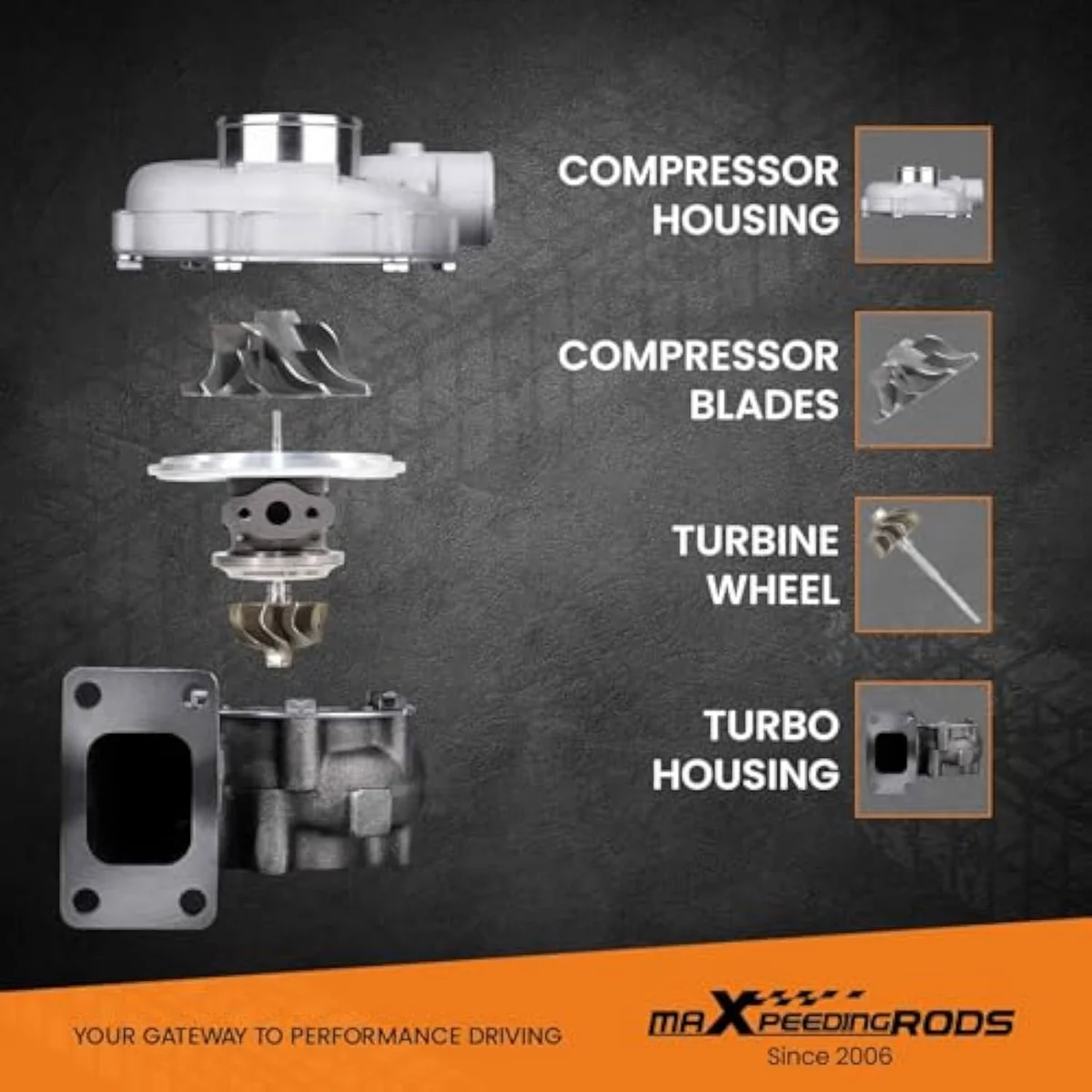
For the broader architectural background on what a turbocharger actually does, see the Read the turbocharger overview — covers the six structural components and the three variant families that map to different OEM applications.
The Architectural Difference
Both compress intake air to force more oxygen into the cylinders. The energy source differs: a supercharger is crankshaft-driven via a belt, gear, or chain; a turbocharger is exhaust-gas-driven through a turbine wheel coupled to the compressor by a shared shaft.
That single difference cascades into every operating characteristic. The supercharger spins in proportion to engine RPM at all times, so boost arrives instantly the moment the driver presses the throttle. The turbocharger spins in proportion to exhaust mass flow, so boost arrives only when the engine is moving enough exhaust to drive the turbine — typically 2,200-3,500 RPM minimum on most frame sizes. Below that band, the turbo produces little to no boost; the engine drives like its naturally-aspirated displacement. Above that band, boost arrives suddenly and holds steady through the rest of the RPM range.
"Hellcat owners pick supercharger because the whine-and-go character matters more than MPG. Cruze 1.4L owners get turbocharger because the EPA cycle wins. Same forced-induction principle, two different markets with two different priority orders." — r/cars synthesis on the modern-OEM and performance-aftermarket split between the two architectures.
Where Turbochargers Win
Turbochargers win on fuel economy, peak horsepower-per-dollar, packaging flexibility, and aftermarket frame-size depth — the four reasons every modern OEM passenger-car platform picked turbocharging when fuel-economy regulations forced the decision.
Fuel economy: at cruise the turbocharger spins at low boost (1-3 psi) and the engine behaves thermodynamically like a smaller naturally-aspirated unit. A 1.4-liter turbo at cruise burns roughly the fuel of a 1.4-liter NA engine; a 2.0-liter NA replaced by a 1.4-liter turbo runs 15-25% better cruise MPG on EPA testing. Superchargers cannot match this part-throttle MPG advantage because the mechanical drive load is constant.
Peak horsepower-per-dollar: turbocharged engines convert exhaust energy that would otherwise be wasted out the tailpipe. The compression work is essentially free above the spool-up RPM, so the same engine can produce higher peak power with less crankshaft load than a supercharged equivalent. Packaging flexibility: a turbo mounts on the exhaust manifold and can be placed close to the cylinder head or remote-mounted in the chassis. Superchargers must sit at the front of the engine, driven by an accessory belt — fixed packaging that constrains intake design. Aftermarket build options: every major frame supplier (Garrett, BorgWarner, Holset, Mitsubishi, IHI, Precision) builds turbocharger frames in displacement-matched sizes from 200-2,000+ horsepower; the aftermarket supercharger market is much narrower (primarily Eaton M-series, Whipple twin-screw, ProCharger centrifugal, Vortech centrifugal).
Where Superchargers Win
Superchargers win on throttle response, tuning simplicity, thermal management, and cartridge mechanism wear life — the four reasons performance-purist OEM applications (Hellcat, ZR1, GT500) stay supercharged.
Throttle response: a supercharged engine delivers boost the instant the throttle opens. There is no spool-up delay, no lag pocket, no off-boost driveability problem. This is the structural reason that performance-purist OEM applications stay supercharged — the response character defines the driving experience.
Tuning simplicity: a supercharger has no exhaust-side complexity. No wastegate spring to manage, no variable-geometry actuator to fail, no exhaust manifold heat-soak, no oil supply line to the bearing housing on a hot exhaust component. The system is mechanically simpler, easier to tune, and has fewer wear components to fail. Heat profile: the supercharger sits at the front of the engine, drawing intake air through an air-to-water intercooler typically integrated into the intake manifold. The thermal management is contained to the cool side of the engine bay; the exhaust side stays clear. Turbochargers concentrate heat at the exhaust manifold, requiring shielding to protect adjacent components and creating an under-hood heat soak that the supercharged architecture avoids.
Reliability of the cartridge mechanism: supercharger rotor packs and snout-shaft bearings are slower-wearing than turbocharger ball-bearing center cartridges under aggressive cycling. A modern OEM Eaton M-series supercharger routinely runs 200,000-300,000 miles with minimal service beyond pulley-belt replacement. The structural reason: the supercharger never sees the 1,500-1,800°F exhaust-side temperatures that wear turbocharger components from the back side.
Twin-Charging — When You Want Both
Twin-charging combines a supercharger and a turbocharger on one engine to eliminate the tradeoff at the cost of system complexity. Volkswagen, Volvo, and several heavy-duty diesel applications ship factory examples.
The factory Volkswagen 1.4 TSI Twincharger (2005-2017) is the most-volume production example. A Roots-type supercharger handles boost from 0-2,400 RPM (zero-lag low-end response), a Garrett GT1444 turbocharger handles boost from 2,400 RPM upward (efficient peak power), and an electronically-controlled bypass valve transitions between the two systems. Net result: a 1.4-liter engine produced 180 horsepower with diesel-like torque from idle.
Aftermarket twin-charge builds exist but remain uncommon outside dedicated racing. The mechanical complexity (two compression sources, multiple bypass valves, custom intake plumbing) adds enough weight, parts cost, and tuning challenge to offset the dynamic benefit on most road builds. The Volvo XC90 T8 Polestar uses a similar architecture (electrically driven supercharger plus exhaust-driven turbo on a 2.0-liter four-cylinder) and achieves similar driveability. The Cummins 6.7L heavy-duty pickup applications use a related concept called compound twin-turbo — two turbochargers in series rather than a supercharger plus a turbo — for similar low-end response on heavy-towing duty cycles.
Cross-Shop — How to Decide for Your Application
Picking the right architecture for an aftermarket build comes down to three priority decisions: primary use case, budget envelope, and OEM-platform aftermarket compatibility lean.
What is the build's primary use case: daily driving with occasional spirited use, weekend track/autocross, drag-race, or fleet-tow heavy duty? Daily-driving and fleet-tow applications usually win with turbocharging because the fuel-economy advantage carries through the cruise miles that dominate the duty cycle. Drag-race and short-burst applications usually win with supercharging because peak horsepower-per-pound and zero-lag response matter more than MPG. Track and autocross usually win with turbocharging if the build is purpose-engineered for the application (proper intercooler, anti-lag tuning) or supercharging if simplicity matters more than peak.
What is the budget envelope for the kit plus install plus tune? Aftermarket bolt-on supercharger kits (Whipple, Magnuson, ProCharger, Vortech, Edelbrock) on common platforms (Hemi 5.7L / 6.4L, GM LS, Ford 5.0L Coyote) run $7,000-$12,000 installed with tune. Aftermarket bolt-on turbo kits on the same platforms run $4,000-$8,000 installed with tune for similar peak horsepower. Custom builds skew the math; off-the-shelf kits with documented dyno data make the comparison straightforward.
What is the OEM platform's compatibility lean? Some platforms have well-developed aftermarket supercharger support and weak turbocharger support (most modern Hemi V8 builds skew supercharged because the kit market is mature). Some platforms have the opposite lean (most modern Honda B-series / K-series builds skew turbocharged because the OEM K20A supercharger conversion kits never reached the depth of the turbocharger market). Talk to the platform-specific build community before locking in the architecture choice.
For deeper engineering background, the Turbocharger reference covers compressor-and-turbine architecture across BorgWarner, Garrett, and Mitsubishi suppliers. The Supercharger reference covers the Roots-type, twin-screw, and centrifugal mechanical-drive architectures that compete with turbocharging across OEM and aftermarket applications. The Turbo University reference publishes industrial-tier balance-and-test discipline data comparable to OEM standards. The Turbocharger Rebuilding Distribution catalog covers the OE manifest network the industrial-supply tier cross-references for fleet-procurement decisions.
When the Buyer Has Picked Turbocharging — Brand-Tier Cross-Shop
Once the architecture decision lands on turbocharging, the next decision is which brand tier fits the build target. See the Read the cross-engine roundup for the picks at each tier.
The premium performance lane (400-1,000+ horsepower) splits between Garrett (broader catalog, denser OEM cross-reference) and Precision (focused on the performance lane, closer per-build documentation). Below 400 horsepower on a daily-driver OE-replacement application, OEM-aftermarket (Garrett aftermarket, BorgWarner OEM) competes against budget-tier cross-references (A-Premium, Ingkan, Filterup) on a per-application basis where the depreciation-adjusted spend can favor the budget tier on entry-level chassis. The Read the Ingkan 55565353 review covers that budget-tier decision on the Cruze 1.4L Garrett GT1446V install base.
For the Garrett-side brand-tier breakdown, see the Read the Garrett brand-tier guide covering GT, GTX, and G-series performance lines plus Garrett OEM applications. For the Precision-side brand-tier breakdown, see the Read the Precision Turbo brand-tier guide covering PT5862 / PT6266 / PT6766 frame sizes and the journal vs ball-bearing decision. For diagnosing turbo failures on the chosen architecture, the Read the four-stage repair decision guide covers the four-stage decision tree (Clean → Actuator → Cartridge → Complete) and the cost bands per chassis lane.
Forced-Induction Decision Questions
- Which is better, a turbocharger or a supercharger?
- Neither is structurally better — they solve the same airflow-increase problem with different engineering tradeoffs. Turbochargers win on fuel economy (1-3 psi at cruise behaves thermodynamically like a smaller naturally-aspirated engine) and on peak horsepower-per-dollar. Superchargers win on transient throttle response (no lag) and on tuning simplicity (no exhaust-side complexity). Every modern OEM passenger-car platform that added forced induction since 2008 picked turbocharging — fuel-economy regulations drove the decision. Performance-aftermarket purist applications (Hellcat, Demon, ZR1 Corvette) keep going supercharged because the response character matters more than MPG.
- Why do new cars use turbochargers instead of superchargers?
- EPA CAFE fuel-economy regulations. Turbocharger downsizing replaces a 2.0L naturally-aspirated engine with a 1.4L turbo at equivalent peak horsepower and 15-25% better cruise fuel economy. The supercharger architecture cannot match that part-throttle MPG advantage because the supercharger is mechanically driven by the engine at all times — even at cruise it pulls 5-8 horsepower of parasitic load to spin the rotors. Manufacturers chasing fleet-average MPG targets (37.0 mpg by 2025 versus 24.1 mpg in 2010) picked turbocharging for the structural reason that turbos lighten up at cruise.
- Are superchargers more reliable than turbochargers?
- Modern OEM applications from both categories deliver comparable reliability when oil-change and PCV-system discipline holds. Supercharger reliability advantages: no exhaust-side heat soak, no variable-geometry actuator failure mode, no oil-supply restrictor on the bearing housing. Supercharger reliability disadvantages: rotor coupling wear, snout-shaft bearing wear, intercooler reservoir leaks. Turbochargers from Garrett / BorgWarner / Holset / Mitsubishi / IHI on 2015-onward OEM applications routinely reach 120,000-200,000 miles. Superchargers from Eaton / Lysholm / Whipple / Magnuson on the same vintage routinely reach 150,000-250,000 miles. Both win when service intervals are observed.
- What is the main disadvantage of a turbocharger?
- Turbo lag — the time delay between throttle input and boost arrival. A turbocharger uses exhaust gas energy to spin its turbine wheel, and the exhaust gas has to build up to enough mass flow to drive the wheel. Below the spool-up RPM band (typically 2,200-3,500 RPM depending on frame size), the turbo produces little to no boost; the engine drives like its naturally-aspirated displacement. Above the spool-up band, boost arrives suddenly. Variable-geometry turbos, twin-scroll designs, and ball-bearing center cartridges all reduce but never eliminate the lag profile. Superchargers have no lag because they spin in proportion to engine RPM at all times.
- What is the main disadvantage of a supercharger?
- Parasitic drag — the supercharger pulls horsepower from the crankshaft to drive its own compression work. A 600-horsepower Hellcat 6.2L Hemi supercharger consumes roughly 80-100 horsepower of parasitic load at peak boost to make its 707 horsepower of net output. Same engine without the supercharger: roughly 480 horsepower naturally aspirated. The supercharger adds 220+ horsepower of net output but consumes 80-100 horsepower of input load to do it. Turbochargers are nearly free at part throttle and only add parasitic load (exhaust backpressure) under high boost. The MPG impact of a supercharger is therefore consistent across the entire load range; the MPG impact of a turbo concentrates at high load only.
- Can you put both a supercharger and a turbocharger on the same engine?
- Yes — the architecture is called twin-charging or compound boosting. The factory Volkswagen 1.4 TSI Twincharger (2005-2017) used a Roots-type supercharger for low-RPM boost (zero lag) and a Garrett GT1444 turbocharger for high-RPM boost (efficient peak power). Volvo XC90 T8 Polestar uses a similar architecture. Aftermarket twin-charge builds are uncommon outside dedicated racing because the system is mechanically complex, requires custom intake plumbing, and adds enough weight to offset the dynamic benefit on most road builds. Cummins 6.7L heavy-duty pickups use a similar concept but with two turbochargers (compound twin-turbo) rather than a supercharger plus a turbo.
- Does a supercharger make more power than a turbocharger?
- At equal engine displacement and equal boost pressure, the net horsepower output is similar — both compress the same air at the same pressure ratio. The difference is HOW the power arrives. A supercharger delivers full boost at low RPM and tapers off at high RPM as the parasitic drive load grows. A turbocharger delivers little boost at low RPM, ramps up to full boost at the spool-up band, and holds it across the rest of the powerband. Net dyno comparison usually shows supercharger curves with peak torque at 3,500-4,500 RPM and turbocharger curves with peak torque at 4,500-6,000 RPM. The chassis dynamics determine which curve wins.
Get Product Updates
Updates only when something changes.
Only when something changes. Unsubscribe anytime.