Updated
Why the 1.4L Turbo Fails
Every Cruze 1.4L turbo failure traces back to one root cause: the factory PCV system lets crankcase oil mist into the intake stream, the oil hits the compressor wheel at supersonic blade-tip speed, and the leading edge of each compressor blade erodes over time.
The Honeywell Garrett GT1446V variable-geometry turbo on the LUJ (2011-2015) and LUV (2016-2019) is a competent piece of engineering on paper. The frame is sized correctly to the 1,364cc displacement, the variable-geometry vane mechanism gives broad torque from 1,800 RPM upward, and the bearing system is conventional journal-and-thrust. The mechanical design is not the problem. The problem is what the engine sends through the compressor inlet.
GM specified a PCV system on the 1.4L Ecotec that uses a diaphragm-actuated valve in the intake manifold. The diaphragm hardens and tears between 60,000 and 100,000 miles. When the diaphragm fails, crankcase pressure climbs, oil mist gets pushed past the rings and through the PCV port directly into the intake stream upstream of the turbo. The compressor wheel then ingests an oil-laden airstream every running mile. At 80,000-150,000 RPM compressor speeds, the leading edge of the blades wears down by a few thousandths of an inch a year — invisible to the eye for years, then catastrophic when the blade balance shifts past the bearing's tolerance for radial load.
The fault chain is consistent across the Cluster A install base. Loss of power between 2,000-3,000 RPM under load is the first symptom. The OBD-II scanner pulls a P0299 code (turbocharger under-boost). Oil consumption climbs from a quart every 5,000 miles to a quart every 1,500-2,000 miles. Eventually the compressor wheel disintegrates, sends shrapnel through the intercooler, and the car goes into limp mode. From P0299 first appearance to compressor failure is typically 3,000-15,000 miles depending on how aggressively the car is driven.
Dealer vs Aftermarket Math
Dealer quotes for the 1.4L turbo replacement run consistently in the $1,800–$2,400 range across the US market. Labor accounts for 4-6 billable hours at $150–$200 per hour, plus the OEM part at $600–$900 wholesale plus markup.
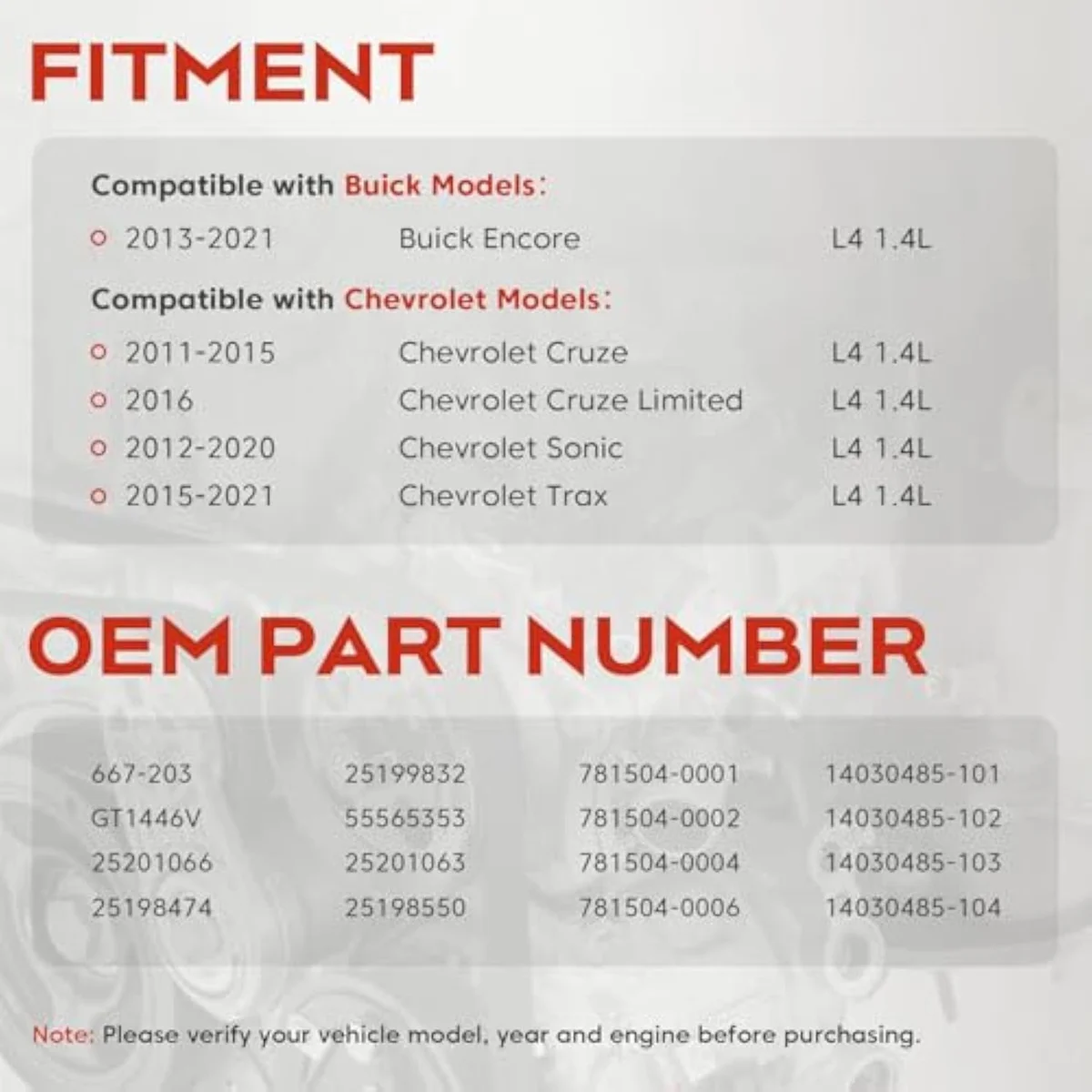
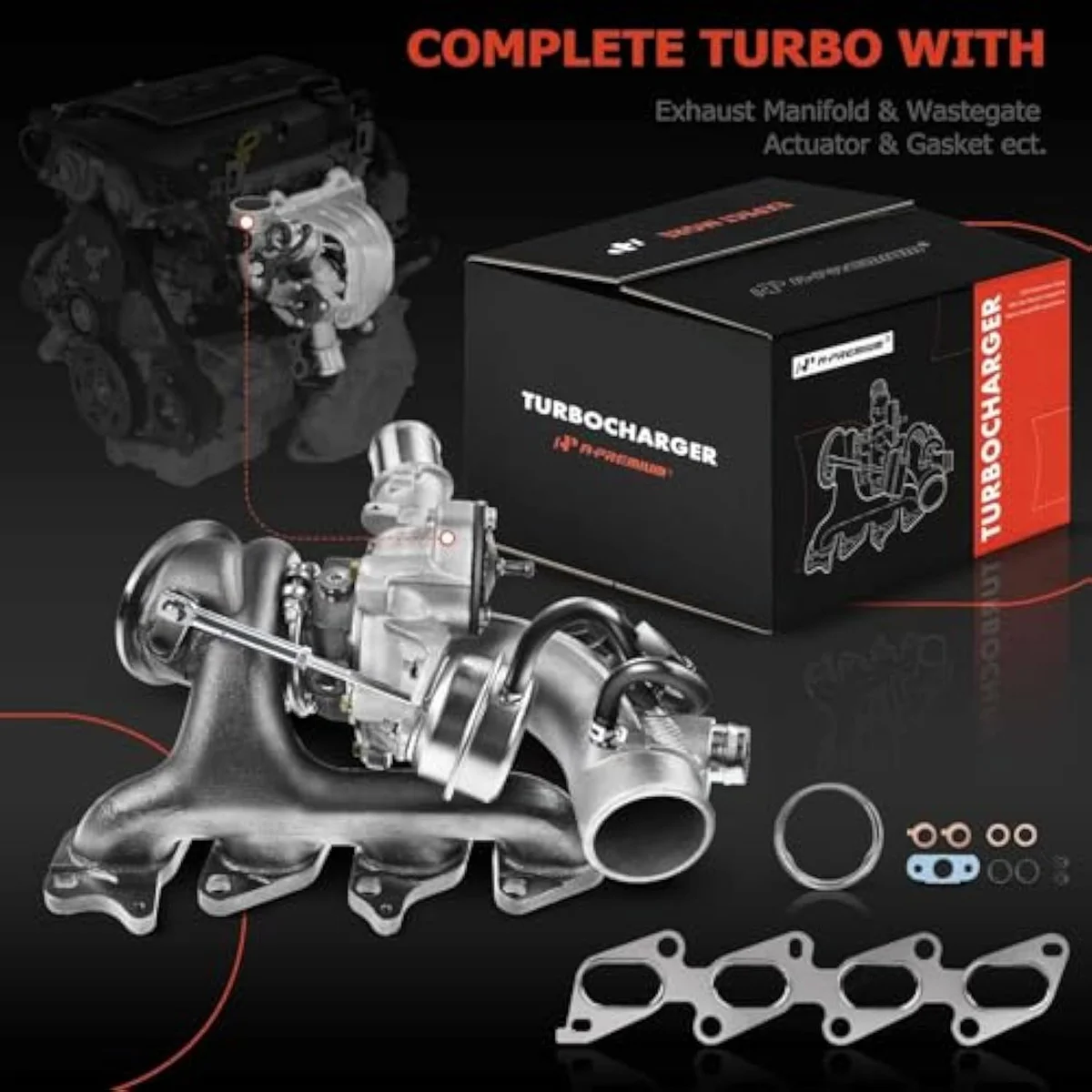
Aftermarket complete-turbo kits on Amazon range from $150 (Tekkoauto, Newzq) to $300 (A-Premium, Filterup), all sharing the same OE 55565353 / 667-203 / GT1446V cross-reference family. Most ship with a gasket kit; some ship with the wastegate actuator pre-installed, some require reusing the original actuator. Install labor at an independent shop runs $300–$500 if the manifold studs come off cleanly, and $500–$800 if the studs snap and have to be drilled out and re-tapped (a common Cruze 1.4L install gotcha — old studs corrode and seize after a decade of heat cycling).
The structural savings against dealer breaks down to: $1,200–$1,500 in parts savings (dealer-OEM vs Amazon-aftermarket) plus $400–$700 in labor savings (independent shop vs dealer rate). Total savings vs dealer: $1,000–$1,500 if everything goes smoothly. The number narrows to $700–$1,000 if the studs snap and add $200–$400 of extra labor. The math still wins on a daily-driver Cruze worth $4,000–$8,000 in book value, where a $2,400 dealer bill represents 30-40% of the car's value and a $700 aftermarket-plus-labor bill represents 9-12%.
"Used Holset turbo on Ebay for $150, pulled from a Dodge Cummins. Beat on that thing for 3 years now with no issues. No shaft play, not a drop of oil in either housing. CXRacing turbo housings, on the other hand, split right down the casting seam. Scary stuff." — r/cars synthesis on the cheaper-than-dealer path. The instinct generalizes to Cruze 1.4L: trust the salvage-tier or audited-reman path; treat the no-name budget-housing path with skepticism. The Cluster A bench sits between those poles — branded reman with verified Amazon-reviewer cohorts is the structural fit.
Confirm the Diagnosis First
A P0299 code by itself is not enough to commit to a $700 replacement. Three other failure modes throw the same code on the 1.4L Ecotec, and each has a different fix at a different price. The architecture context behind each failure mode lives in the Turbocharger Types — Taxonomy and Comparison reference; the OEM background on the GT1446V variable-geometry frame is documented at Garrett Motion's turbo selection guide.
Failure mode one: vacuum leak. A torn intake-boot rubber or a failed PCV diaphragm can leak air past the MAF sensor and trigger P0299 without the turbo being damaged at all. Smoke-test the intake before assuming the turbo is gone — a smoke machine at any independent shop costs $40-$80 for the test. If smoke escapes through the intake boot or the PCV diaphragm, you have an $80 fix, not a $700 fix.
Failure mode two: stuck wastegate actuator. The vacuum-actuated wastegate on the 1.4L can stick open after years of vacuum-line aging. The turbo itself is fine; the actuator is just leaking vacuum. Replacing the actuator alone runs $80–$150 at parts cost and 1 hour of labor — far cheaper than a complete turbo replacement.
Failure mode three: clogged or failed catalytic converter. A partially-collapsed cat traps exhaust backpressure upstream of the turbo, reducing boost output. The OBD-II reports under-boost because the turbo cannot spool against the restricted exhaust. Replacing the cat ($800–$1,200) is the actual fix; replacing the turbo wastes money. A backpressure test at any exhaust shop catches this in 15 minutes. The diagnostic protocol that shop technicians apply to confirm which failure mode is the root cause is documented in the rebuilder-tier reference at Rotomaster's Understanding Turbochargers guide and the OE cross-reference manifest at Turbo University.
The Eight-Listing Aftermarket Bench
Eight Amazon listings share the OE 55565353 / 667-203 / GT1446V cross-reference family for the Cluster A install base. We've reviewed all eight on the site; the short version of how to navigate them is below, and the full Cluster A roundup covers each in depth.
The top pick is the A-Premium B09NXQGBYX complete turbo kit. 4.31 / 5 across 13 verified Amazon reviews, complete gasket kit included, pre-installed wastegate actuator, and the deepest install-kit completeness in the cohort. This is the conversion target for most readers — buy this, fix the PCV at the same time, and the install is a 4-6 hour project on a flat-rate Saturday.
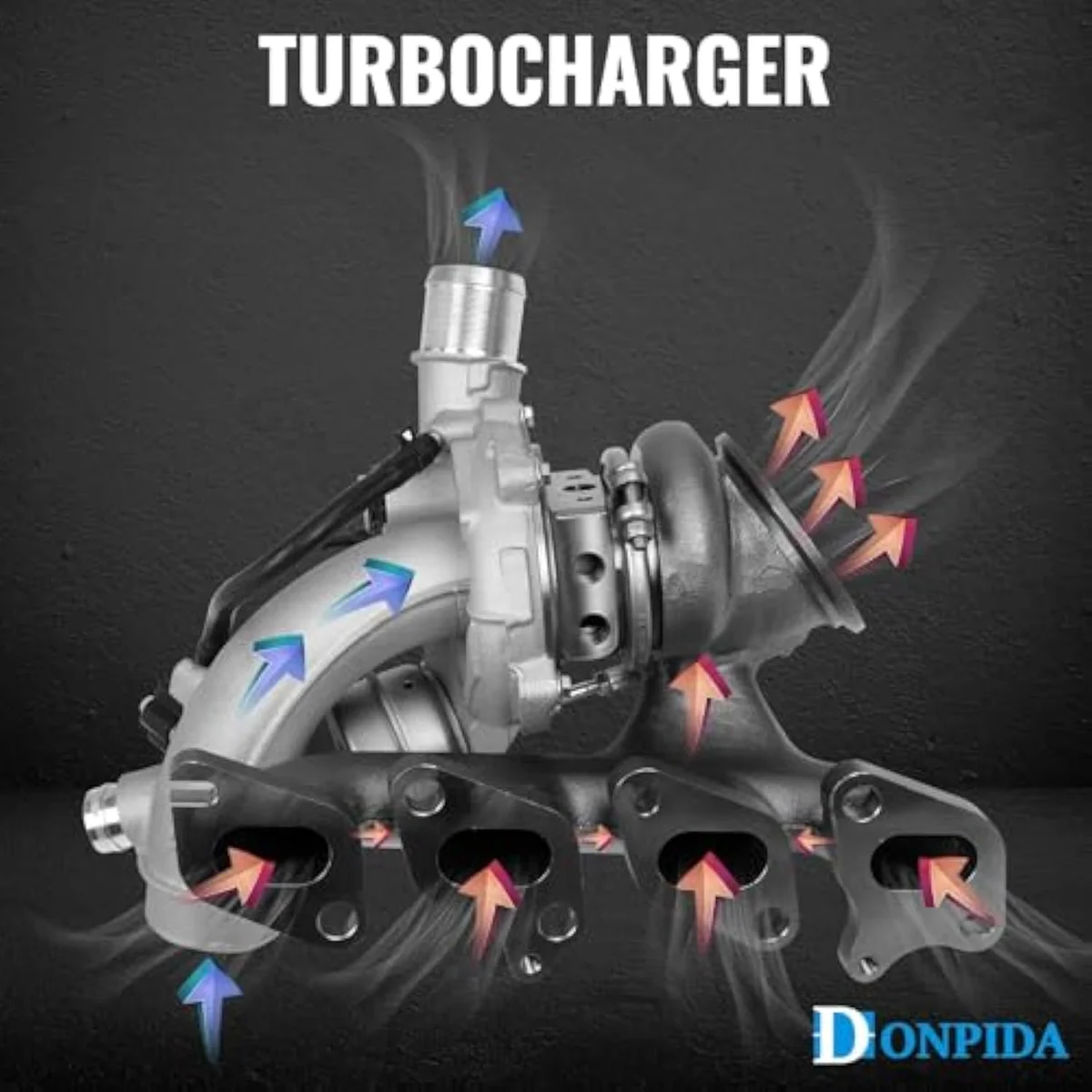
The first runner-up is the Filterup 667-203 with the longest OE cross-reference list — it names alternate GM internal stamps 25201066 / 25198474 / 25199832 that the A-Premium top pick does not list explicitly. Useful if you're cross-referencing a specific GM dealer-parts catalog number. The Donpida is the material-spec play: it's the only listing in the bench naming a 700°C heat-resistant casting alloy and its review thread leans on r/Cruze community context. The Newzq names a nickel-based casting alloy at the same price as the Filterup. The Autobaba is a cross-shop on the same OE chain at a slightly lower price point. The Tekkoauto carries the deepest r/ChevySonic community-thread footprint with documented install outcomes and failure modes.
Two listings are install-kit siblings of the others. The A-Premium turbo-plus-installation-kit (B0BRC1MQR5) is a different SKU from the B09NXQGBYX top pick — same physical turbo, different kit packaging. The Ingkan is the only listing that names the GT1446V model code explicitly in the product title, which matters if you're buying from a parts-counter person who only recognizes the model code.
Install Completeness Checklist
The aftermarket savings vanish if the install drags on for an extra day because the kit is missing a $4 gasket. The eight listings vary in what they include. Confirm before clicking buy.
What you need: the turbo itself, exhaust-manifold-to-turbo gasket (rectangular), turbo-to-downpipe gasket (round), oil-feed-line gasket (two crush washers), oil-drain gasket (rubber or paper), coolant-line gaskets (two crush washers), intake-side air boot clamp, wastegate actuator (pre-installed or separate), and the four exhaust-manifold studs and nuts. If your existing studs snap during removal — a near-universal Cruze 1.4L experience past 100,000 miles — you also need a stud extractor kit ($30–$60) and replacement studs ($15 for a set of four).
Of the eight Cluster A listings, the A-Premium B09NXQGBYX top pick and the Filterup ship the most complete kits — both include all gaskets and the actuator. The Tekkoauto and Autobaba ship gasket kits but require reusing the original actuator. The Newzq and Donpida ship the turbo only; gasket kit purchased separately. The cross-reference family is identical, but the install-bag is not. Buying the cheaper turbo-only listing and a separate $30 gasket kit ends up the same total cost as the A-Premium kit, with one extra Amazon order and a one-day shipping delay if Prime stock fluctuates.
Our Conversion Pick
For 80% of Cruze 1.4L readers landing on this page after a P0299 dealer-quote sticker shock, the structural answer is the A-Premium B09NXQGBYX complete turbo kit plus a same-time PCV diaphragm fix (the GM dealer part for the diaphragm is under $50 and the install is on-engine while the turbo is out). Total project cost: $250–$350 in parts, $300–$500 in independent-shop labor if you're not doing it yourself, $500–$800 if you are. Against the $1,800–$2,400 dealer estimate, the savings funds either a year of regular maintenance or covers the deductible on the next mechanical surprise the car throws at you.
The minority case where the A-Premium is not the right answer: if you specifically need the alternate GM internal-stamp cross-reference (Filterup) or the heat-resistant casting-alloy spec (Donpida), buy those. Both are competent. The full Cluster A roundup covers the situational fit for each. Our paired knowledge primer on how a turbocharger works covers the architecture context if you want the engineering picture before you commit.
Check Price on Amazon — A-Premium B09NXQGBYX
Cruze 1.4L Replacement Questions
- How much does it cost to replace a turbocharger on a Chevy Cruze?
- Dealer estimates land at $1,800–$2,400 for parts and labor on a Cruze 1.4L turbo replacement. Aftermarket complete-turbo kits sharing OE part numbers 55565353 / 667-203 / GT1446V sit at $150–$300 on Amazon, and independent-shop install labor adds $300–$500. The structural savings against dealer is $1,000–$1,500 if the aftermarket part holds up. The hidden cost is fixing the PCV system at the same time — skip that step and the new turbo dies on the same schedule as the original.
- How long do Chevy Cruze turbos last?
- The factory Honeywell Garrett GT1446V on the LUJ and LUV 1.4L Ecotec engine typically fails between 80,000 and 130,000 miles — early by modern turbo standards. The proximate failure is compressor-wheel erosion at the inducer tip, and the upstream root cause is the factory PCV system letting crankcase oil mist into the intake stream. The oil hits the compressor at supersonic blade-tip speed and erodes the leading edge over years of accumulated cycles.
- What is the life expectancy of a Chevy Cruze 1.4 turbo?
- Plan on 80,000–130,000 miles under stock PCV and 130,000–180,000 miles if the PCV is upgraded or actively maintained. Oil-change discipline matters: synthetic at every 5,000 miles instead of the extended OEM interval extends life on the high end. Drivers who let oil go to 10,000-mile intervals saw failures closer to the 60,000-mile end.
- Is it safe to drive a Cruze with a bad turbo?
- Drivable, but expensive fast. The car will throw a P0299 under-boost code and run on limp-mode airflow — usable, but underpowered and burning oil into the catalyst. Continued driving costs the catalytic converter ($800–$1,200 to replace), risks oil-starvation damage to the bottom end, and can break a piston ring landing if the compressor wheel disintegrates and sends shrapnel through the intake. Replace the turbo within a few weeks of the code, not a few months.
- What is the recall on the Chevy Cruze turbo?
- There is no factory recall on the 1.4L turbo itself. GM did issue technical service bulletins (TSBs) for PCV diaphragm failure (TSB PIE0376) and intake-manifold valve failure (TSB 17-NA-178). Both TSBs target the upstream root cause of turbo failure but do not extend warranty coverage on the turbo. Owners who fixed the PCV / intake-manifold issue under TSB are the ones reporting the highest replacement-turbo longevity. The forum nickname "Cruze recall on the turbo" usually refers to these TSBs, not a NHTSA recall.
- What size turbo is on a Chevy Cruze?
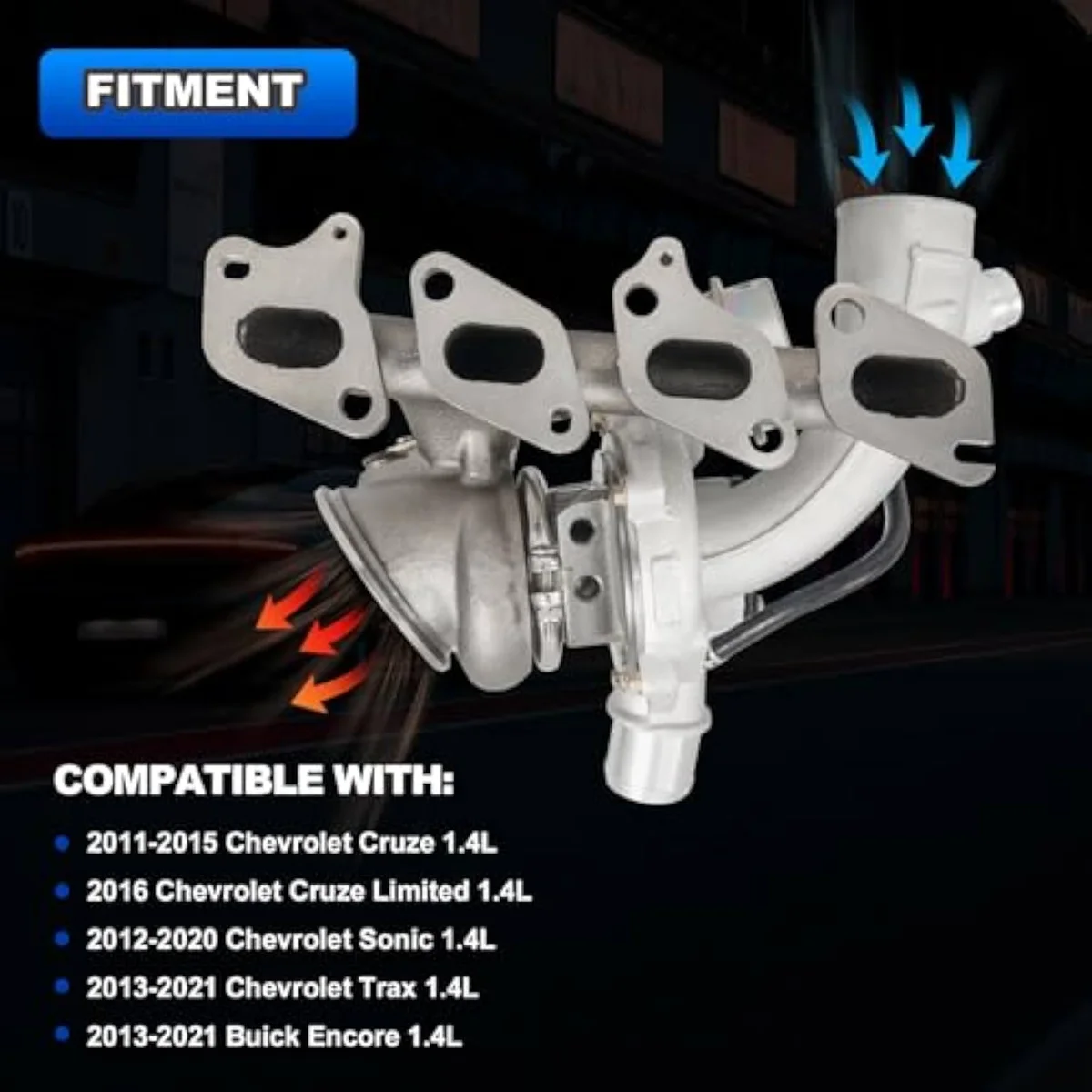
- The 1.4L Ecotec LUJ (2011-2015 Cruze) and LUV (2016-2019 Cruze) use a small-frame variable-geometry compressor sized to the 1,364cc displacement — Honeywell Garrett GT1446V family, 41mm inducer / 53mm exducer compressor wheel, 39mm inducer / 43mm exducer turbine wheel. The frame is the same across Cruze, Sonic, Trax, and Buick Encore for the 1.4L applications. Same physical turbo, same OE part-number family, minor calibration differences between LUJ and LUV.
- Is it worth it to replace a turbocharger on a Chevy Cruze?
- For a Cruze with a clean body, working transmission, and otherwise solid mechanicals, yes — the aftermarket savings vs dealer plus the structural option of fixing the PCV at the same time makes the replacement economically rational up to about 180,000 miles. For a Cruze with multiple other major repairs pending (transmission, suspension, head gasket), the replacement-turbo spend can exceed the trade-in value of the vehicle. Get an honest pre-purchase inspection on those other systems before committing.
Get Product Updates
Updates only when something changes.
Only when something changes. Unsubscribe anytime.