Updated
Why Every New Car Is Turbocharged
EPA CAFE fuel-economy regulations drove the industry-wide shift. The standard required fleet-average fuel economy to climb from 24.1 mpg in 2010 to 37.0 mpg by 2025. Manufacturers responded with turbo-downsizing: replace a naturally-aspirated 2.0L engine with a 1.4L turbo at equivalent peak horsepower and 15-25% better cruise fuel economy.
The economics work because the turbo only adds substantial fuel use under heavy load. At part-throttle cruise, the engine runs at 1-3 psi of boost, behaving thermodynamically like a smaller naturally-aspirated engine. Under full throttle, the turbo pumps boost to 15-25 psi and the engine produces peak power equivalent to a larger NA engine. Average daily driving spends 80-90% of operating time in the part-throttle band where the smaller engine wins on efficiency, and only 10-20% in full-throttle where the turbo lifts power above the smaller engine's baseline.
"Every Ford F-150 EcoBoost owner reports 1-2 mpg better than the same year/trim 5.0L V8 truck at cruise. Under load with a trailer, the V8 wins on MPG. Average for daily use, the EcoBoost is the structural winner." — r/F150 thread synthesis, on the real-world MPG gap between turbo-downsized and naturally-aspirated variants of the same chassis.
Major Passenger-Car Install Bases
Five manufacturers anchor the passenger-car turbo install base in the US market. Each picked a different supplier and a different architectural strategy.
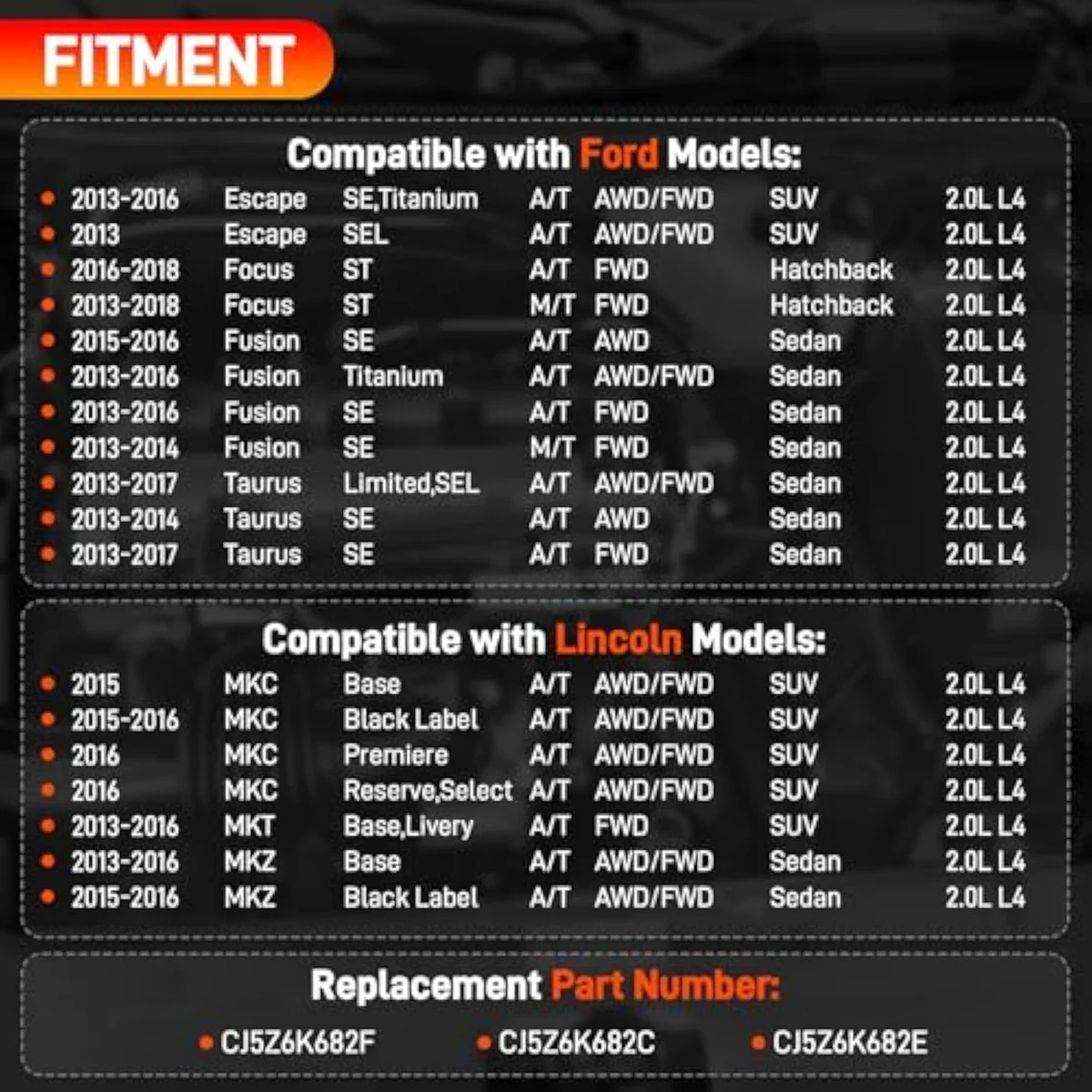
Ford EcoBoost is the broadest install base. The 1.0L three-cylinder (Fiesta, Focus US through 2018), 1.5L four-cylinder (Escape, Fusion, Bronco Sport), 1.6L four-cylinder (Escape, Fusion, MKZ), 2.0L four-cylinder (Escape, Focus, Fusion, Taurus, Edge, Explorer, MKC, MKT, MKZ), 2.3L four-cylinder (Focus RS, Mustang EcoBoost, Bronco, Explorer ST), 2.7L V6 (F-150, Edge ST, Bronco), and 3.5L V6 (F-150, Expedition, Navigator, Transit). All EcoBoost engines use BorgWarner K-series or Honeywell Garrett GT-series turbochargers depending on application.
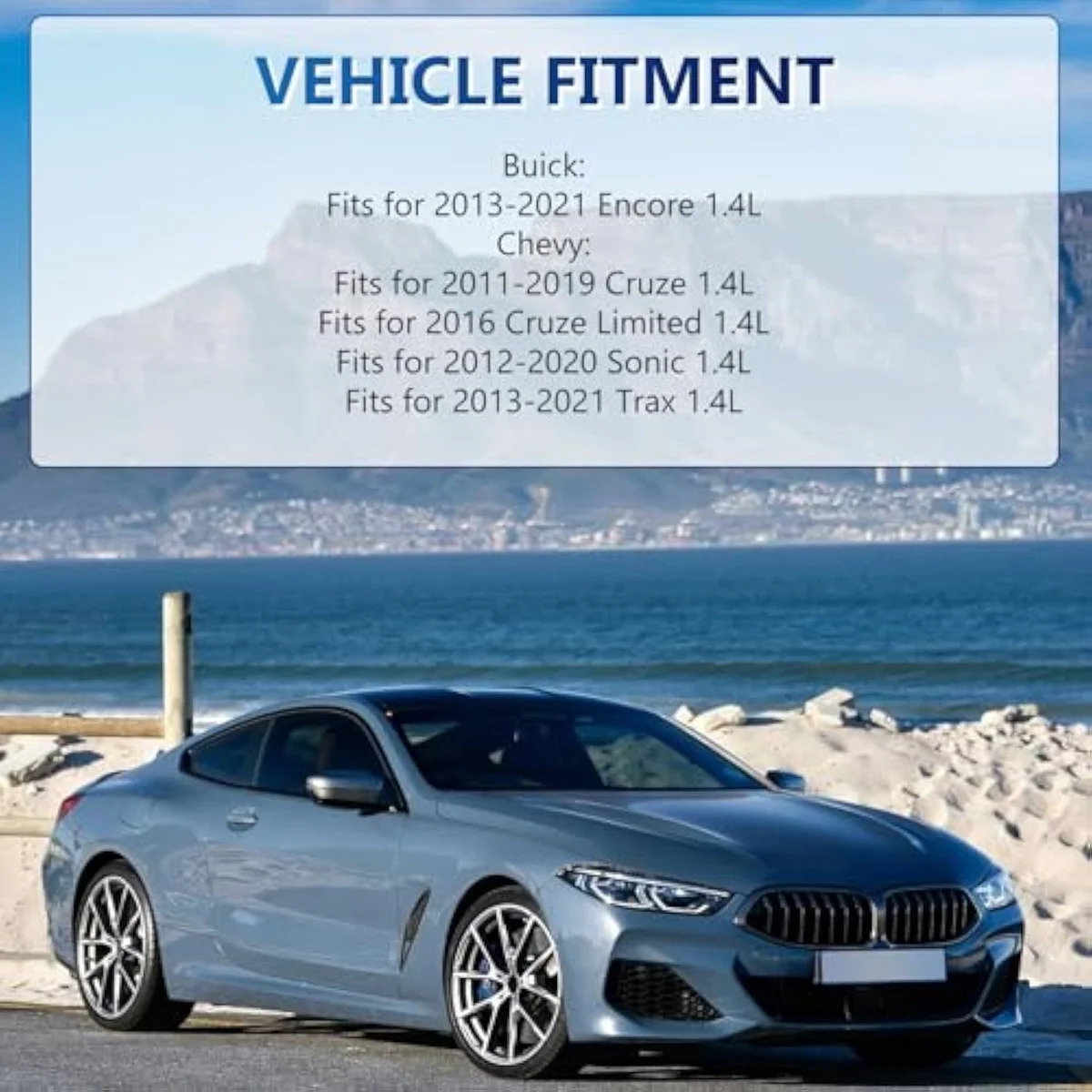
General Motors 1.4L Ecotec is the second-largest install base. The LUJ (2011-2015) and LUV (2016-2019) ship on the Cruze, Sonic, Trax, Buick Encore, and several global variants. Both use Honeywell Garrett GT1446V variants — same OE part-number family with minor calibration differences between LUJ and LUV. The 2.0L LTG (Camaro, ATS, CTS Vsport) uses a twin-scroll BorgWarner K04 — different architecture, different OE chain, no cross-shop with the 1.4L.
Diesel Passenger-Car and Light-Truck Turbos
Diesel applications have run turbocharged since the 1980s — diesel engines compress air to higher pressures than gas, so turbocharging is structurally efficient for diesel even before fuel-economy rules. Cummins 6.7L on the 2007.5-2025 Ram 2500/3500/4500/5500 pickup family uses the Holset HE351VE (2007.5-2012) and HE300VG (2013-2025) variable-geometry frames. Ford Power Stroke 6.7L on the 2011-2025 Super Duty uses Honeywell Garrett GT3782VAS / GT3788LVA designs. GM Duramax 6.6L on the 2001-2025 Silverado/Sierra HD uses BorgWarner K03 (early) and Honeywell Garrett VGT (mid/late) variants.
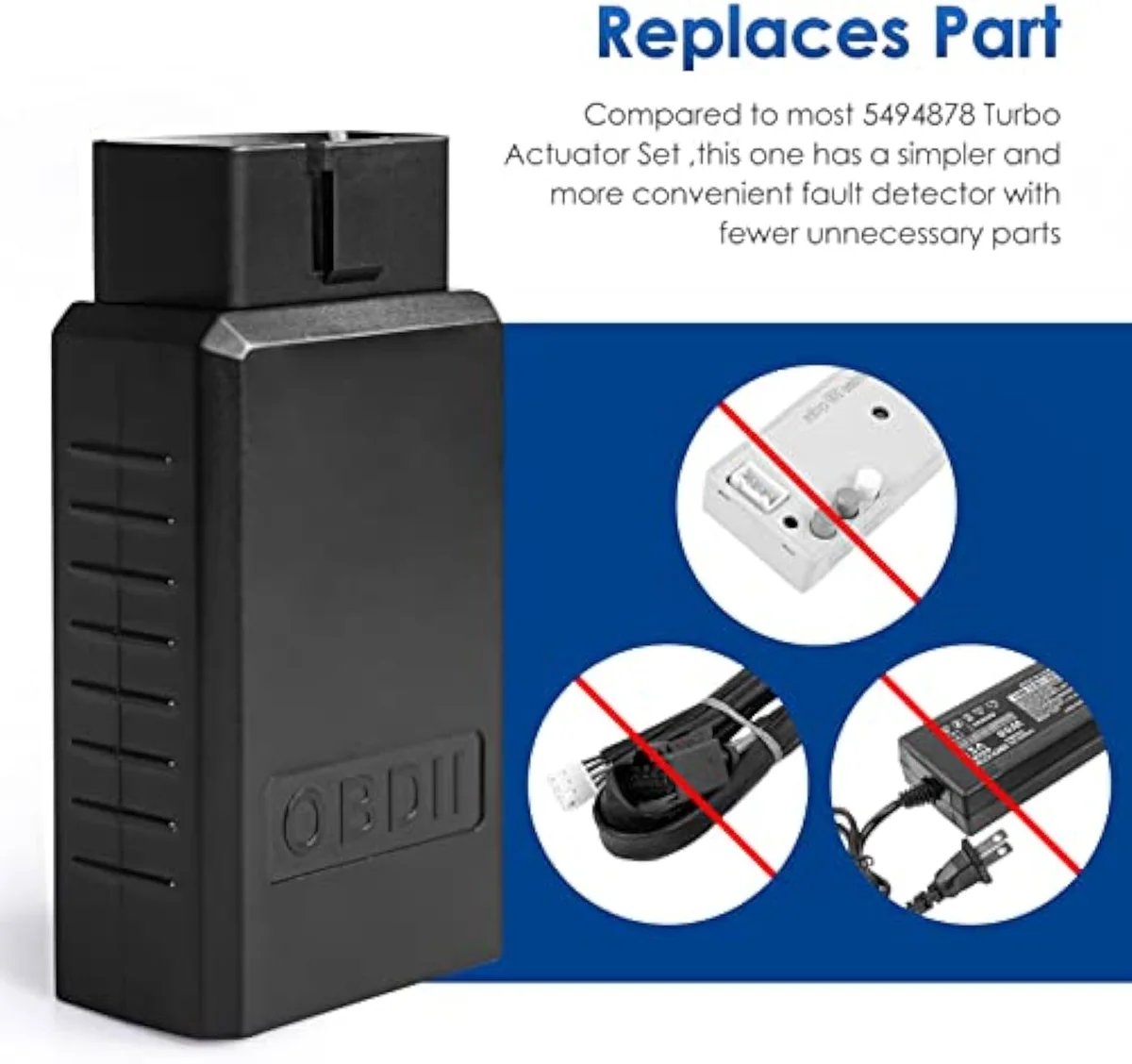
For the specific actuator-only diagnostic path on Cummins 6.7L Ram pickup applications (P003A code, mechanical side of the turbo intact), the Read Full Review of WOLLAHS 5494878RX covers the OE part chain, calibration tooling, and warranty terms. For Ford EcoBoost 2.0L applications specifically (one of the broadest install bases in the US fleet), the Read the GDUKOP CJ5Z6K682C review covers the broader-chassis envelope (Escape / Focus / Fusion / Taurus + Lincoln MKC / MKT / MKZ) at the entry-tier price band.
Reliability by Platform — Where the Failures Land
Not all turbo platforms are created equal. Three OEM failure patterns account for most of the reliability complaints across the passenger-car install base.
Chevy Cruze 1.4L: the LUJ frame's documented PCV-failure root cause. The factory PCV system on the LUJ allows excessive crankcase pressure to push oil mist into the intake stream; the abrasive oil then erodes the compressor wheel at supersonic tip speeds. Cruze owners typically see the failure at 80,000-130,000 miles — early by industry standards. The fix requires PCV replacement BEFORE the turbo replacement, otherwise the new turbo dies on the same schedule. Ford EcoBoost 1.6L: carbon-buildup intake-valve cleaning every 60,000-80,000 miles. The direct-injection design means fuel never washes the back of the intake valves; carbon accumulates and degrades airflow. Walnut-shell blasting at 80,000 miles is the maintenance fix. BMW N20: timing-chain guide failure at 60,000-100,000 miles — not a turbo failure directly, but the related repair often surfaces alongside turbo replacement on the same maintenance visit.
For the engineering background on which turbo design fits which engine family, the Turbocharger reference covers compressor-and-turbine architecture across BorgWarner, Garrett, and Mitsubishi suppliers. The Turbo University Turbocharger reference publishes OE cross-reference manifests for the most-fitted passenger-car frames. The Understanding Turbochargers Guide covers the rebuilder-tier diagnostic protocol shops apply across passenger-car and heavy-duty applications. The Turbocharger Rebuilding Distribution catalog publishes the OE manifest network the industrial-supply tier cross-references for fleet operators.
Replacement Implications for Owners
Knowing the install base tells you what the replacement path looks like when failure happens. Three patterns dominate.
Pattern 1: high-volume OE replacements at low-three-figure cost. Cruze 1.4L (OE 55565353 / 667-203 / GT1446) and Ford EcoBoost 2.0L (OE CJ5Z6K682-X / 53039880271) both have wide aftermarket-replacement options at $150-$700. The dealer quote is $1,800-$3,300 on these chassis; the savings against dealer makes aftermarket the structural winner for daily-driver budgets. Pattern 2: mid-tier specialty rebuilds for heavy-duty applications. Cummins 6.7L Ram and Ford Power Stroke 6.7L Super Duty have rebuilder-tier alternatives (BD Diesel, Industrial Injection, KC Turbos) at $1,200-$2,000 that match or exceed dealer-rebuilt quality with comparable warranty depth. Pattern 3: premium-tier OEM-only paths on luxury and performance applications. BMW M-series, Mercedes-AMG, Audi RS, and Porsche turbo applications often have NO aftermarket-replacement option that meets calibration spec — dealer-OEM or specialty rebuilder is the only path. The math: $4,000-$8,000 at the dealer. The same risk-adjusted spend framing applies whether the chassis is a daily-driver Cruze, a heavy-duty Cummins Ram pickup, or a luxury performance BMW M-series — what differs is the breadth of the aftermarket bench, the warranty depth on the OE alternative, and the calibration-tooling constraint on the cheaper path.
For the broader four-stage repair decision tree across all three patterns, see the Read the turbocharger repair decision guide. For cross-engine aftermarket picks across the passenger-car and heavy-duty install bases, see the Read the cross-engine roundup.
Turbocharged-Car Decision Questions
- Which Chevrolet cars have turbochargers?
- The Cruze 1.4L LUJ (2011-2015) and LUV (2016-2019) Ecotec, Sonic 1.4L (2012-2020), Trax 1.4L (2013-2021), Buick Encore 1.4L (2013-2021), and the Camaro 2.0L LTG (2016-2024) all ship with factory turbochargers. The 1.4L Ecotec uses a Honeywell Garrett GT1446V on the LUJ and a slightly revised frame on the LUV. The 2.0L LTG on the Camaro uses a twin-scroll BorgWarner K04 design — different architecture, different OE chain, no cross-shop with the 1.4L parts.
- Which Ford cars have turbochargers?
- Every EcoBoost variant — the 1.0L 3-cylinder, 1.5L 4-cylinder, 1.6L 4-cylinder, 2.0L 4-cylinder, 2.3L 4-cylinder, 2.7L V6, and 3.5L V6. The 2.0L EcoBoost ships on the Focus, Escape, Edge, Explorer, Fusion, Taurus, MKC, MKT, and MKZ in various model years. The 3.5L EcoBoost V6 ships on the F-150, Expedition, and Navigator. The 2.7L EcoBoost ships on the F-150, Edge, Bronco, and Fusion Sport. All EcoBoost engines use BorgWarner K-series or Honeywell Garrett GT-series turbochargers depending on application.
- Which BMW cars have turbochargers?
- Since 2008 essentially every BMW gas engine has been turbocharged. The N20 (2.0L 4-cylinder), N26 (2.0L 4-cylinder ULEV), N55 (3.0L inline-6 single-turbo), B58 (3.0L inline-6 single-turbo replacing N55), S55 (3.0L twin-turbo M-performance), N63 (4.4L V8 twin-turbo), and S63 (4.4L V8 twin-turbo M-performance) all ship turbocharged. Most use twin-scroll Mitsubishi or BorgWarner designs; the V8 applications use Honeywell Garrett twin-turbos.
- Are turbocharged cars more reliable than naturally aspirated cars?
- For modern OEM applications from 2015 onward, turbocharged engines from Garrett / BorgWarner / Honeywell / Mitsubishi / IHI suppliers match or exceed naturally-aspirated reliability when oil-change discipline is maintained. The exceptions: Chevy Cruze 1.4L (PCV root-cause failure pattern), Ford EcoBoost 1.6L (carbon-buildup intake-valve cleaning intervals), and BMW N20 (timing-chain guides at 60,000-100,000 miles). Heavy-duty diesel turbochargers from Cummins (Holset HE351VE / HE300VG) and Ford Power Stroke routinely reach 200,000-300,000 miles when serviced.
- Why do car manufacturers use turbochargers now?
- Fuel-economy regulations. EPA CAFE standards required fleet-average fuel economy to reach 37.0 mpg by 2025 from 24.1 mpg in 2010. Manufacturers downsized engines (turbo-downsizing) to meet the standard — a 1.4L turbo replaces a naturally-aspirated 2.0L engine while producing equivalent horsepower at peak load and 15-25% better fuel economy at cruise. Every major manufacturer adopted turbo-downsizing by 2018; Toyota was the last holdout and switched their core compact platform to turbocharged 1.5L engines in 2018.
- Are turbo cars expensive to maintain?
- Marginally more expensive than naturally aspirated equivalents. The turbo itself is a wear part with a 120,000-200,000 mile expected lifespan; the replacement cost ranges $1,800-$3,300 at dealer or $150-$700 on Amazon aftermarket. Otherwise, turbocharged maintenance is the same schedule as NA — oil change every 5,000-7,500 miles (synthetic), air filter every 15,000-30,000 miles, spark plugs every 60,000-100,000 miles. The main cost increase is when the turbo fails and the owner faces the dealer-vs-aftermarket repair decision.
- Do turbo engines use more fuel under load?
- Yes, by design. Under full throttle a turbocharged engine pumps more air through the cylinders and the fuel-injection system meters proportionally more fuel to maintain the air-fuel ratio. A 2.0L turbo running 18 psi of boost burns roughly the same fuel-per-second under full load as a 3.5L V6 making the same horsepower. The fuel-economy advantage comes at PART-throttle and cruise loads where the turbo runs at low boost (1-3 psi) and the engine behaves like a 2.0L NA — that is where the 15-25% MPG improvement shows up on EPA-cycle testing.
Get Product Updates
Updates only when something changes.
Only when something changes. Unsubscribe anytime.