Updated
For the foundational mechanism background, see the Read the mechanism explainer — twin-scroll changes the inlet architecture, not the rest of the thermodynamic loop or the six structural components.
What Twin-Scroll Architecture Actually Does
Twin-scroll architecture divides the exhaust manifold and turbine housing into two parallel scrolls that pair cylinders whose firing-order positions place their exhaust pulses 360° of crankshaft rotation apart. The two scrolls feed one turbine wheel without interfering, eliminating the back-pressure pulse interference that single-scroll designs suffer below 3,000 RPM.
The structural problem twin-scroll solves: in a single-scroll design, all four cylinder exhaust pulses (on a 4-cylinder engine) feed the turbine through one merged manifold passage. At low engine RPM, the cylinder pulses are spaced widely enough that one pulse arrives at the turbine before the previous pulse has cleared. The unfinished pulse creates back-pressure against the next cylinder\'s exhaust valve at scavenging, costing 5-10% of available exhaust energy. Twin-scroll architecture eliminates that pulse interference by routing pulses 360° apart down separate passages — each cylinder sees a clear path to the turbine when its exhaust valve opens.
"The twin-scroll architecture is why BMW B58 inline-6s feel naturally aspirated until 2,500 RPM and then hit hard. The single-scroll N54 had a noticeable lag pocket; the B58 does not. Same displacement, same target horsepower, two different scroll architectures." — r/BMW synthesis on the N54 → B58 generational change and the impact of switching to twin-scroll inlet design.
Firing-Order Pairing — How the Cylinders Get Grouped
The pairing rule is simple: cylinders separated by 360° of crankshaft rotation share a scroll. On a 4-cylinder with firing order 1-3-4-2, cylinders 1+4 pair and 2+3 pair. On a BMW B58 straight-6 with firing order 1-5-3-6-2-4, cylinders 1+2+3 feed one scroll and 4+5+6 feed the other.
On a 4-cylinder engine with the standard 1-3-4-2 firing order, cylinders 1 and 4 fire 360° apart and cylinders 2 and 3 fire 360° apart; those are the two pairs. On a straight-6 with firing order 1-5-3-6-2-4 (BMW B58, Toyota 2JZ, Mercedes M256), cylinders 1+2+3 (front three) feed one scroll and 4+5+6 (rear three) feed the other.
The fabrication implication is that a twin-scroll manifold is structurally a more complex casting than a single-scroll equivalent — two parallel passages that maintain separation all the way to the turbine flange. The divider partition between scrolls must survive 1,500-1,800°F exhaust gas temperatures without warping, which requires thicker-section castings or stainless-steel weld construction on aftermarket fabricated manifolds. OEM applications use heavy-section iron castings; aftermarket performance applications typically use schedule-40 stainless tubing with stamped or laser-cut dividers welded into the merge.
OEM Twin-Scroll Deployments — The Production Pattern
Twin-scroll is the default on most 4-cylinder and 6-cylinder OEM turbocharged applications since 2010. BMW N20, Ford EcoBoost 2.0L, Mercedes-AMG M139, Mitsubishi Evo X, Hyundai Theta-II — all twin-scroll. V8 designs typically stay single-scroll due to cross-bank pairing complexity.
BMW gas engines: every twin-scroll application since 2008. N20 / N26 (2.0L 4-cylinder, 240-302 hp), N55 (3.0L inline-6, 300-340 hp), B58 (3.0L inline-6, 320-382 hp replacing N55), S55 (3.0L twin-turbo M-performance, 425-503 hp). Ford EcoBoost: 2.0L EcoBoost Mustang (2015+), 2.0L EcoBoost Focus ST and RS, 2.3L EcoBoost Mustang and Focus RS. Mercedes-AMG: M133 (2.0L 4-cylinder A45 AMG, 355-381 hp) and M139 (2.0L 4-cylinder C63 / GLA45 / GLC63, 416-469 hp). Mitsubishi Evo X 4B11T (2.0L 4-cylinder, 291 hp). Hyundai/Kia N-series Theta-II 2.0L (Veloster N, Elantra N, Kona N).
The exception list — modern OEM turbo applications that stay single-scroll — is dominated by V8 designs where cross-bank pairing complexity outweighs the benefit. Ford 3.5L EcoBoost V6 uses single-scroll because the firing order on a 60° V6 does not pair cleanly. GM 6.6L Duramax diesel V8 uses single-scroll. The Cummins 6.7L inline-6 diesel uses single-scroll variable-geometry because the variable-vane mechanism trades cleanly against twin-scroll on inline-6 designs at the displacement and duty cycle.
Aftermarket Twin-Scroll Frame Options
Three brands lead the aftermarket twin-scroll space. BorgWarner EFR ships twin-scroll standard across the entire EFR-6258 through EFR-9180 catalog. Garrett G-series offers twin-scroll variants on G25-550, G30-660, G35-900, and G42-1200. Precision Turbo offers twin-scroll on selected PT frames.
BorgWarner EFR (Engineered for Racing) ships twin-scroll inlet as the standard configuration across the EFR-6258 / EFR-6758 / EFR-7163 / EFR-7670 / EFR-8374 / EFR-9180 catalog. Garrett G-series offers twin-scroll variants on G25-550, G30-660, G35-900, and G42-1200 frames. Precision Turbo offers twin-scroll variants on selected PT-series frames; the option is not standard across the full PT line.
Cross-shop economics. A BorgWarner EFR-7670 twin-scroll (650-850 hp band, ball-bearing standard, twin-scroll standard) runs $2,800-$3,400. A Garrett GTX3076R single-scroll (500-650 hp band, ball-bearing optional) runs $1,800-$2,400. A Precision PT6266 single-scroll (500-700 hp band, ball-bearing optional) runs $1,500-$2,200. The EFR pays its premium with twin-scroll standard plus the deeper compressor-map documentation BorgWarner publishes. For builds targeting peak power on a 4-cylinder or inline-6 platform, the EFR twin-scroll is the documented community default; for builds targeting peak power on a V8 platform, single-scroll Garrett or Precision is the simpler cross-shop.
For deeper engineering background, the Turbocharger reference covers compressor-and-turbine architecture fundamentals. The Exhaust manifold reference covers the fabrication background that twin-scroll castings extend. The Turbo University reference publishes industrial-tier balance-and-test discipline applicable to twin-scroll designs. The Turbocharger Rebuilding Distribution catalog publishes OE manifest cross-references across both single-scroll and twin-scroll OEM applications.
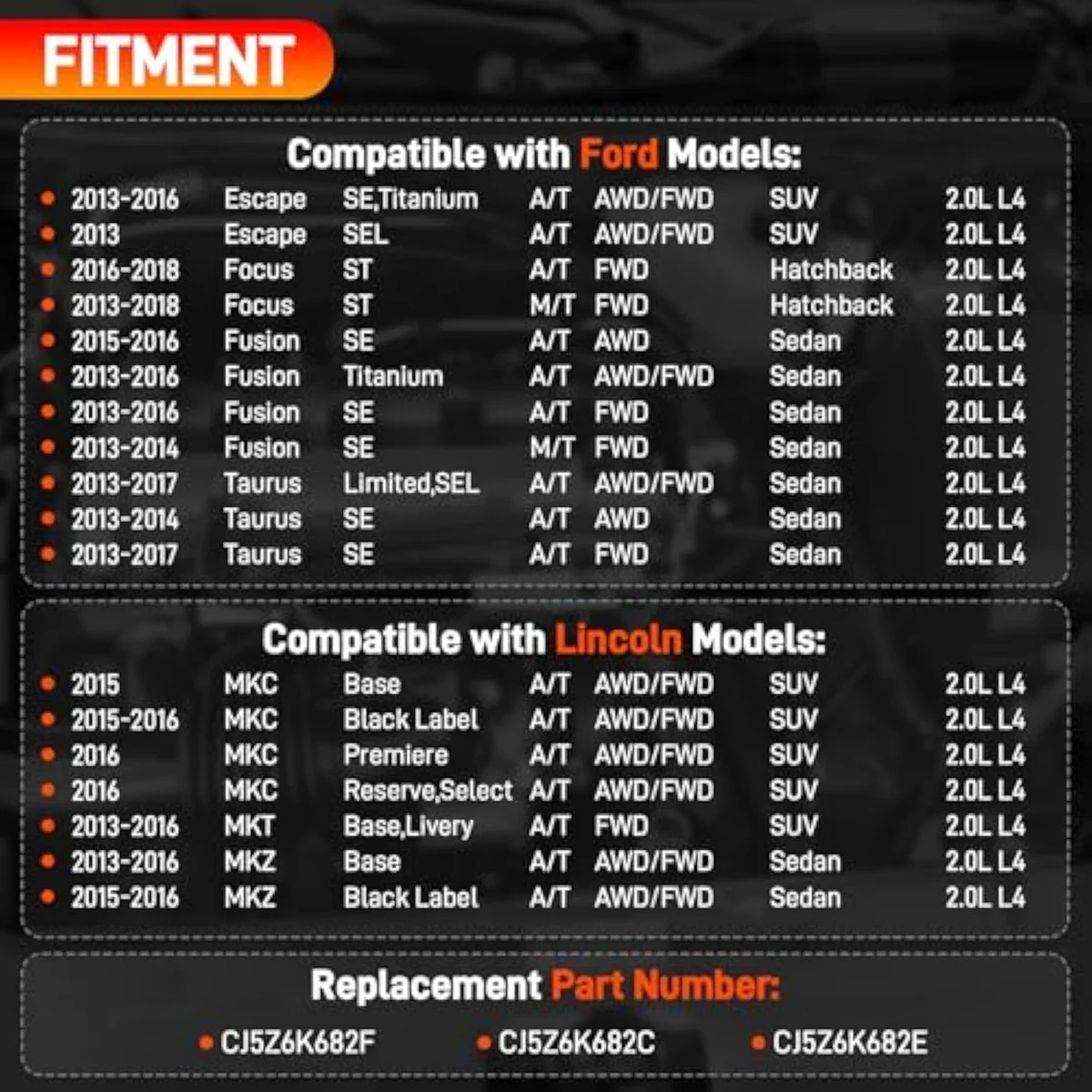
For the specific brand-tier deep dives, the Read the high-performance turbocharger guide covers the three-brand dominance pattern across Garrett, Precision, and BorgWarner. For the EcoBoost 2.0L OEM twin-scroll cross-shop, the Read the GDUKOP CJ5Z6K682C review covers the high-volume 2.0L twin-scroll OEM application across the Escape, Focus, Fusion, Edge, and Lincoln MKC / MKT / MKZ chassis. For the broader cross-engine cross-shop, the Read the cross-engine roundup covers documented OE-replacement and performance picks by chassis lane.
Twin-Scroll Decision Questions
- What is a twin-scroll turbocharger?
- A twin-scroll turbocharger uses a divided exhaust manifold and a divided turbine housing to pair cylinder exhaust pulses that do not interfere with each other. On a 4-cylinder engine with firing order 1-3-4-2, cylinders 1+4 share one scroll and cylinders 2+3 share the other; the pulse timing eliminates the back-pressure interference that single-scroll designs suffer below 3,000 RPM. Net result: spool 800-1,200 RPM earlier on the same frame size, broader torque curve, no lag pocket on most builds.
- Is twin-scroll better than single-scroll?
- For 4-cylinder and 6-cylinder engines with cylinder count divisible into firing-order pairs, yes — twin-scroll spools earlier and produces flatter torque curves without sacrificing peak boost capacity. The exception is V8 engines where pairing across cylinder banks costs more complexity than it saves; many V8 turbo designs stay single-scroll for that reason. The cost gap: a twin-scroll turbo costs $300-$800 more than a single-scroll equivalent at the same frame size; the gain is broad torque and reduced lag below 3,000 RPM.
- Which OEM cars use twin-scroll turbochargers?
- BMW N20 / N26 / N55 / B58 / S55 all run twin-scroll designs. Ford EcoBoost 2.0L Mustang and Focus RS run twin-scroll. Mercedes-AMG M133 / M139 (2.0L 4-cylinder M-series) run twin-scroll. Mitsubishi Evo X 4B11T runs twin-scroll. Hyundai N-series 2.0L Theta-II runs twin-scroll. The architecture is the default on most modern 4-cylinder OEM turbocharged applications since 2010; 3-cylinder and inline-6 applications also commonly use twin-scroll inlets.
- What is the firing order for a twin-scroll turbocharger?
- On a 4-cylinder engine with firing order 1-3-4-2 (standard for most modern 4-cylinder designs), cylinders 1+4 fire at opposite crankshaft positions (180° apart) and cylinders 2+3 fire at opposite positions (also 180° apart). The twin-scroll divided manifold pairs 1+4 into one scroll and 2+3 into the other so the exhaust pulses arriving at the turbine wheel never interfere. On a straight-6 with firing order 1-5-3-6-2-4 (BMW B58), cylinders 1+2+3 share one scroll and 4+5+6 share the other. The pairing rule: cylinders separated by 360° of crankshaft rotation go on the same scroll.
- What does a twin-scroll turbocharger sound like?
- The exhaust note is cleaner and less rumbly than a single-scroll equivalent because the pulse interference that single-scroll designs allow is itself part of the audible character. Twin-scroll designs sound tighter and more responsive but lose some of the "burble" character — Subaru EJ255 / EJ257 single-scroll designs have the characteristic boxer-engine rumble that twin-scroll BMW B58 designs do not. For builders who prefer the exhaust note, single-scroll remains the right pick; for builders who prioritize spool and torque, twin-scroll wins.
- Can twin-scroll turbochargers handle high boost?
- Yes — the architecture imposes no peak-boost penalty. Modern OEM twin-scroll designs (BMW S55, Mercedes-AMG M139, Ford 2.3L EcoBoost on Focus RS) run 22-30 psi of boost with no issue. Aftermarket twin-scroll designs from BorgWarner EFR and Garrett G-series support 40-60+ psi at peak. The twin-scroll inlet improves the low-RPM behavior; it does not constrain the high-RPM peak. The exhaust-side divided housing handles the same gas flow as a comparable single-scroll housing once both are at peak.
- Are twin-scroll turbos more expensive?
- Yes — by $300-$800 per turbo on aftermarket performance applications, and by roughly the same proportional gap on OEM cost-of-goods. The added cost covers the divided turbine housing (more complex casting), the divided exhaust manifold (more complex fabrication), and the divider partition between scrolls that has to survive 1,500-1,800°F exhaust gas temperatures without warping. Most performance brands offer twin-scroll as a premium frame option above the standard single-scroll equivalent.
Get Product Updates
Updates only when something changes.
Only when something changes. Unsubscribe anytime.