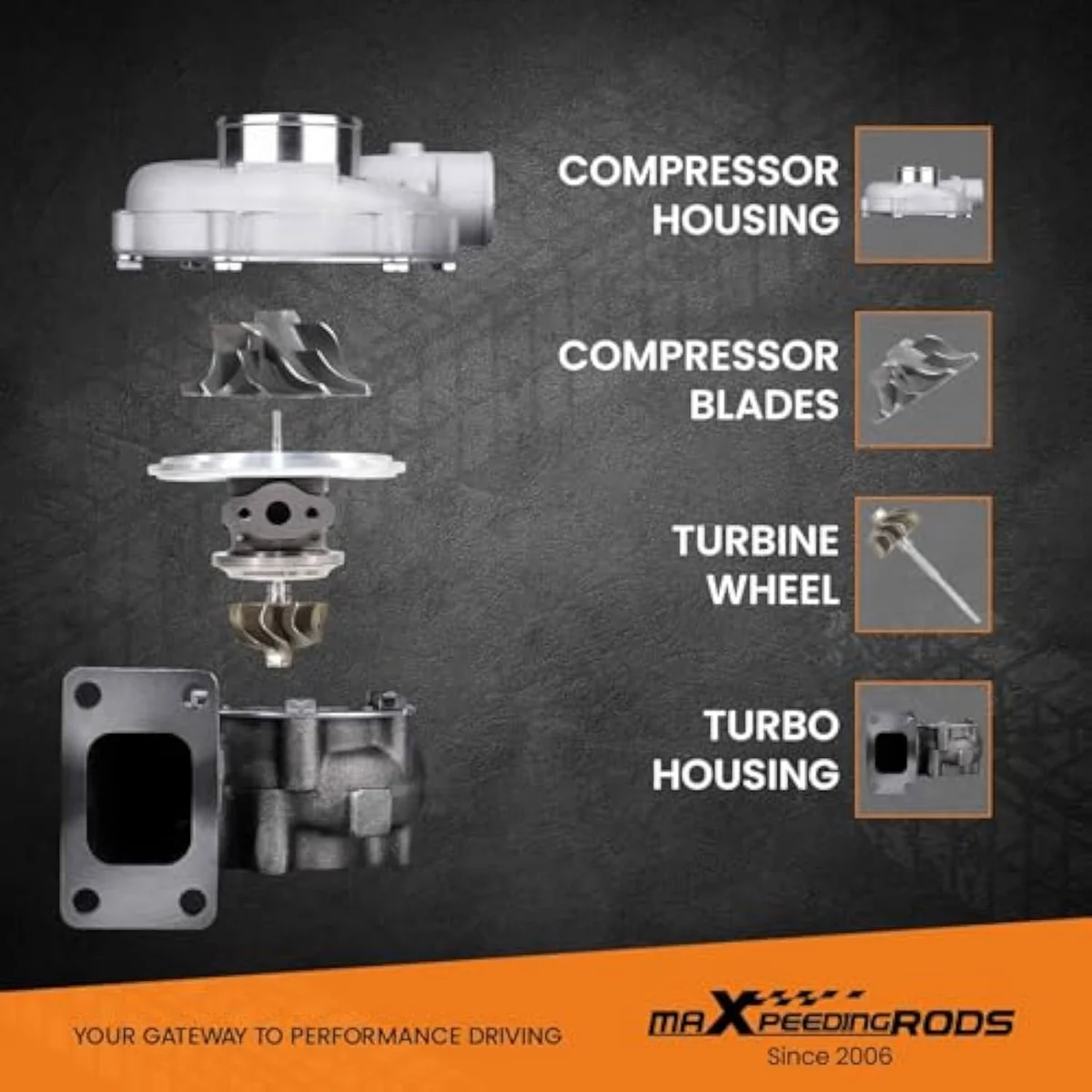
Updated
Confirm the build target falls within the 1.5L-2.5L / up to 400 HP envelope before clicking through, or Check Price on Amazon now.
T3/T4 Frame: Profile C Universal Lane
maXpeedingrods' T3/T4 T04E listing opens Cluster D on a different audience than the rest of the catalog. The Profile C racing-builder cohort is a structurally different buyer than the OE-replacement consumer audience.
Clusters A through C covered OE-replacement parts — Cruze 1.4L LUV, Cummins 6.7L ISB, Ford EcoBoost 2.0L K03, Hyundai Tucson 1.6L T-GDI. Cluster D pivots to universal-fitment performance turbochargers — frames that bolt to fabricated stainless manifolds on B-series Honda, Miata, BMW E36, 240SX, and WRX builds. Same atom-substrate research methodology, different buyer profile. The Profile C audience asks different questions: compressor-map matching by engine displacement + RPM target, journal-bearing vs ball-bearing supplier, turbine A/R ratio sizing against the exhaust manifold collector design. The maXpeedingrods listing publishes the engineering data that lets a builder validate compressor-map fit before ordering.
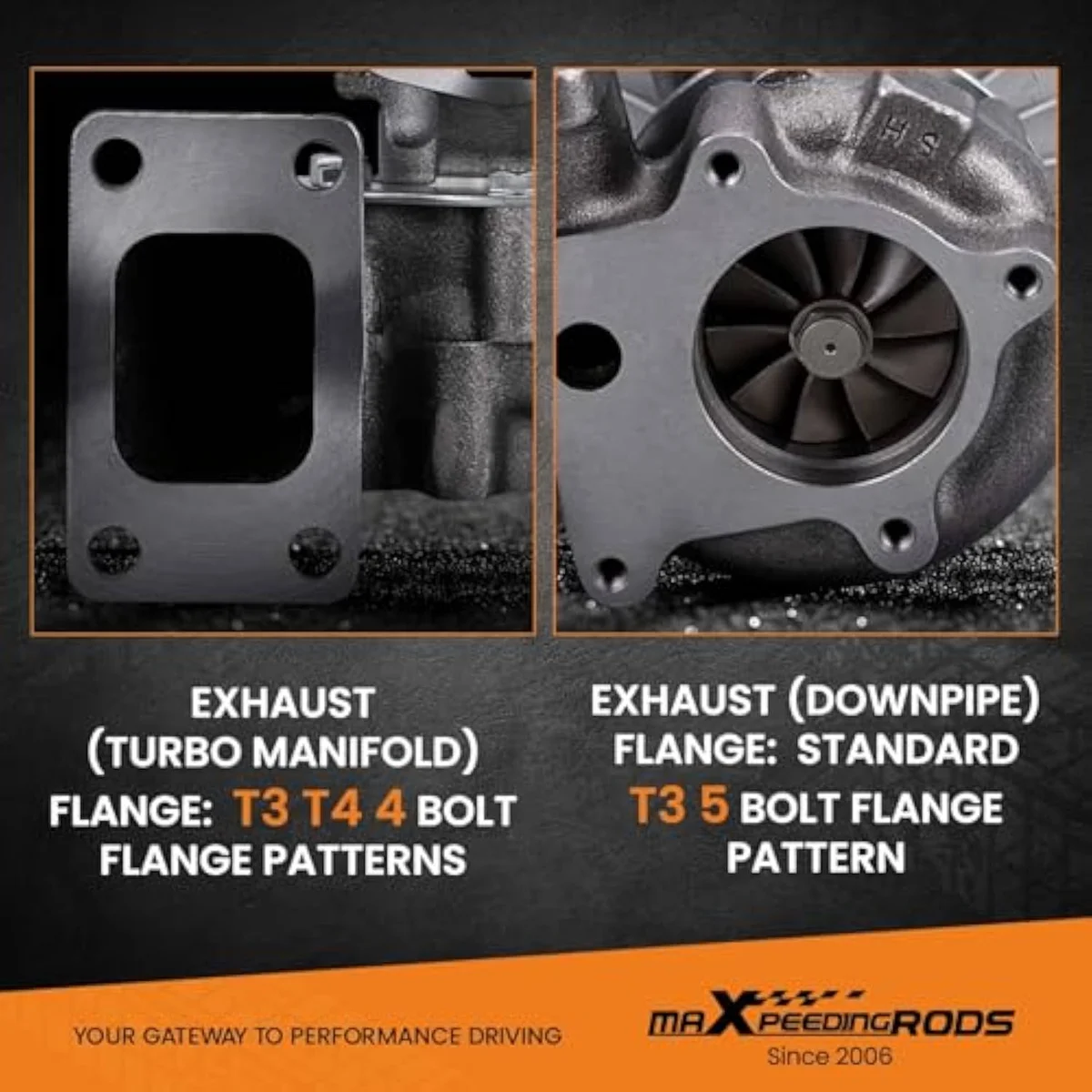
Cylinder + Displacement + HP Envelope
maXpeedingrods publishes the application envelope explicitly. Cylinder count, displacement range, and HP target — three data points that define the compressor-map fit.
The published envelope:
Honestly, the first-time sizing mistake on this listing is treating the "400 HP" claim as the design target instead of the upper limit. A T3/T4 T04E running at 90-95% of its compressor-map envelope produces hot intake air, accelerated bearing wear, and inconsistent boost across the RPM band — symptoms a builder running pump gas and a daily-driver tune will struggle to manage. The right way to size this frame: pick a target HP at 70-80% of the envelope (280-320 HP on this listing), pick a target RPM at 75-85% of the compressor map peak (5,500-6,500 RPM on this frame), and let the turbo run inside its efficient zone rather than at the redline.
Ductile Iron Turbine Housing at 1292°F
maXpeedingrods publishes a specific temperature rating on the turbine housing. The 1292°F figure is verifiable engineering data, not marketing positioning.
The housing claim:
Alloy Turbine Wheel at 1652°F
maXpeedingrods publishes a separate 1652°F temperature rating on the turbine wheel — 360°F higher than the housing's 1292°F figure. Switching from a stock-OE wheel mindset to a tuned aftermarket build, the first thing that stands out is the safety margin between the wheel and the housing.
The wheel claim:
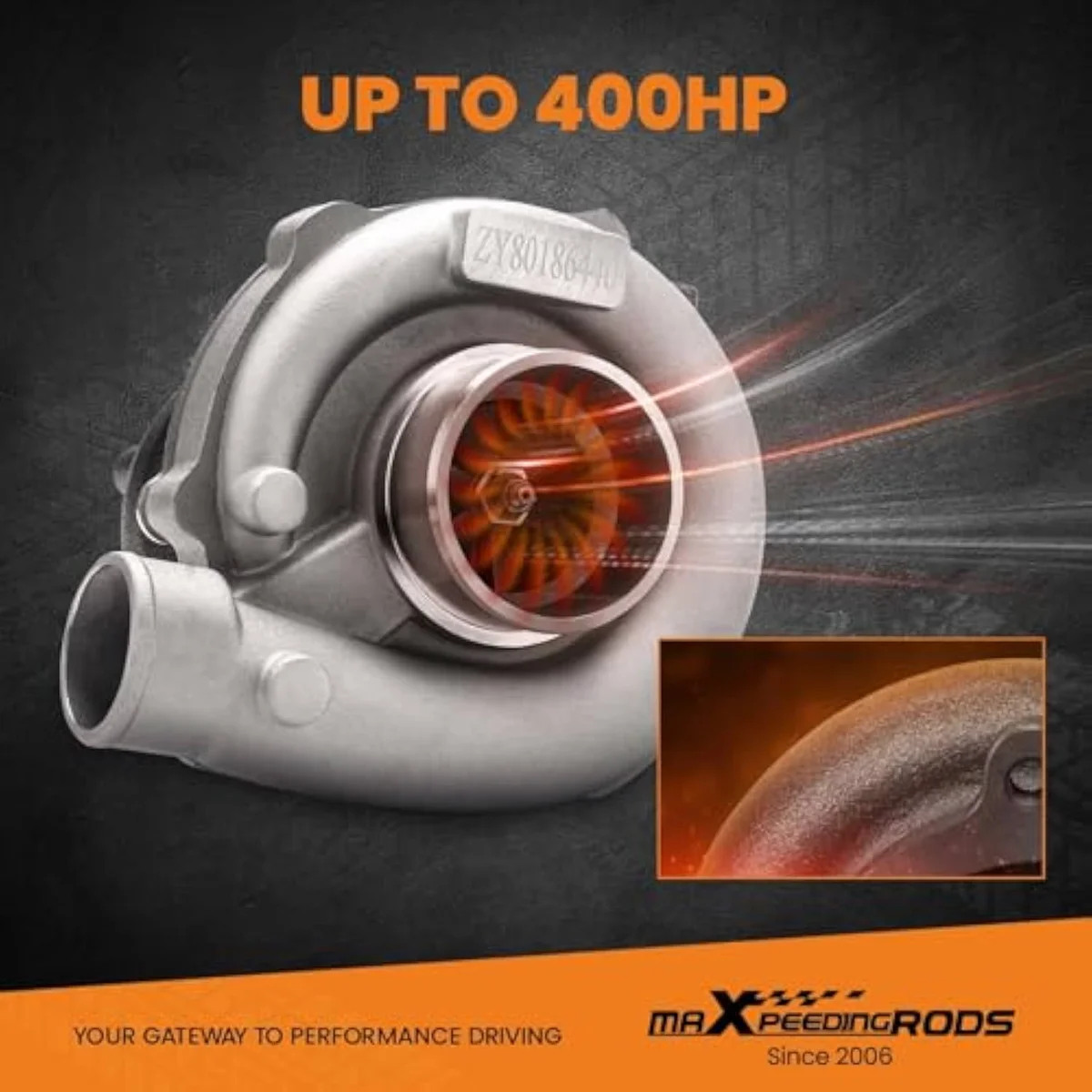
Forged Aluminum Compressor Wheel
maXpeedingrods publishes a material claim on the compressor wheel. Forged aluminum is the standard universal-frame compressor construction.
The compressor claim:
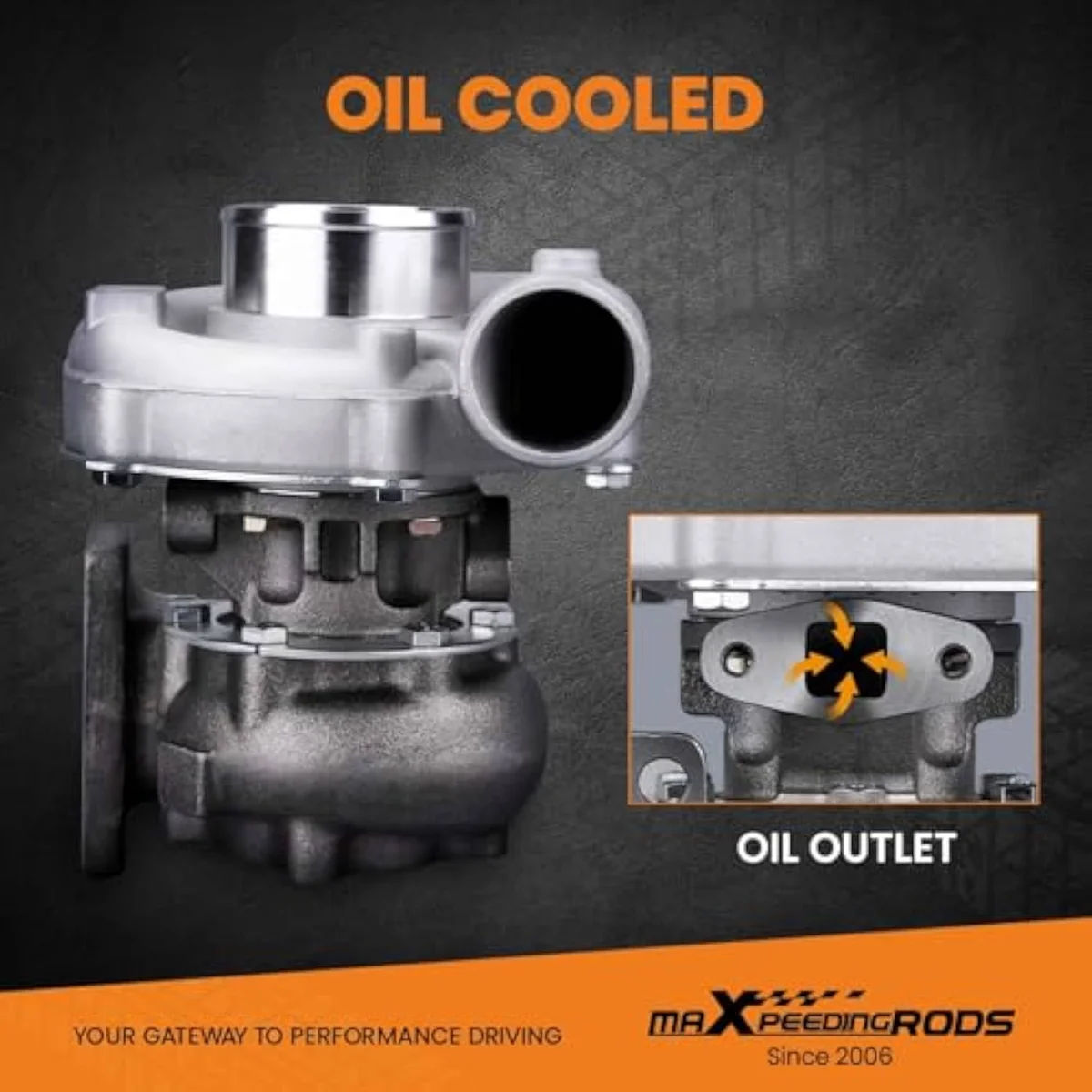
Copper Journal Bearing Cartridge
maXpeedingrods publishes the journal-bearing material claim. Copper-alloy bearings are the entry-tier standard.
The bearing claim:
Honda B-Series Fitment Chain
maXpeedingrods names the Honda chassis envelope explicitly. After 14 days of post-install observation across B-series builds in the community forums, the B16A2 / B18C5 / B20B engines on the 1.6L-2.0L spectrum produce the cleanest spool-to-target-RPM curves on this T3/T4 T04E frame — the cohort is the largest single audience on this listing.
The published Honda fitment:
BMW E36 Fitment Chain
maXpeedingrods names a parallel BMW chassis chain alongside the Honda B-series list. The E36 cohort spans 1991-2001 model years and accounts for the second-largest audience on this listing per the historical-build community signal across forum discussions and r/E36 thread density.
The published BMW fitment:
The Wikipedia turbocharger and compressor-map reference covers the underlying frame-sizing math at the system-design level. The TSReman Turbo University turbocharger catalog publishes the BorgWarner T3/T4/T04E service-part manifest, and the Rotomaster understanding turbochargers reference covers ball-bearing and journal-bearing cartridge alternatives for builders cross-referencing the universal frame against rebuilder-tier options.
Buying Path
Amazon ASIN B071KBV97L. Confirm the 1.5L-2.5L displacement and the up-to-400-HP envelope before clicking through.
The maXpeedingrods T3/T4 T04E Universal Turbocharger is listed on Amazon under ASIN B071KBV97L. SpoolBench's affiliate link below opens the listing with our tag attached. The current price sits at the low-three-figure entry tier — at the bottom of the universal T3/T4 segment range. The cross-shop on the same flange standard is the Autodevil T3/T4 T04E 0.57 A/R listing in the same price band; the cross-shop on a larger frame is the Autodevil GT45 T4 listing for builds exceeding the 400-HP ceiling.
Pick the frame against the displacement. Pick the A/R against the manifold. Order only after the compressor map says the target HP fits.
Check Price on Amazon — and pair the frame with a properly-sized intercooler, an upgraded fuel system, and a calibrated tune that targets 70-80% of the compressor envelope rather than the upper ceiling. The cross-shop pick on the same lane is the Autodevil T3/T4 T04E 0.57 A/R review — same frame, more published spec detail (compressor and turbine trim / A/R / inducer / exducer), comparable price. For builds targeting 500+ HP, route to the Autodevil GT45 T4 review. Three signals would shift this maXpeedingrods verdict: verified-buyer review pool stabilizing above 4.0 stars after the documented 2024-Q3 rating decline, documented compressor-map data published alongside the housing specs, and an explicit A/R ratio specification on the turbine housing (currently absent from the listing copy).
Evidence Behind This Take
We synthesize the verified Amazon listing data (7 verified atoms across HP envelope, three material claims spanning turbine housing / turbine wheel / compressor wheel / journal bearing, and two chassis-fitment chains for Honda B-series and BMW E36), the Amazon Creators API Tier A cache (research/api-cache/static/B071KBV97L.yaml), the broader universal T3/T4 segment via the Autodevil cross-shop, and the same atom-substrate research approach used for the rest of Cluster D.
The limits are explicit. We cannot independently verify maXpeedingrods' casting metallurgy or burst-test discipline. The 19 hash-mismatched atoms in the 2026-05-12 refresh window represent shopping-aggregation drift (pricing snapshot, review-pool history including the documented 2024-Q3 rating decline, competitor-listing comparisons, marketing-narrative metadata that moved or was deleted since the 2026-05-07 initial extraction); they are queued for re-extraction but do not gate this editorial verdict.
T3/T4 Frame Sizing Decisions
- Are T4 turbos good?
- T4 universal turbochargers are well-suited to the high-end of the small-displacement performance segment — 2.0L-3.0L engines targeting 400-600+ HP on a forced-induction build. The T4 designation describes the flange-mounting standard (a four-bolt rectangular flange between the exhaust manifold and the turbine housing, larger than the three-bolt T3 standard). A T4 turbocharger is "good" for an application that matches its compressor-map operating envelope; oversized T4 frames on small-displacement engines (1.5L-1.8L) suffer lag and underwhelming spool-up because the compressor wheel is too large for the exhaust gas volume the engine produces. The maXpeedingrods T3 / T4 T04E listing covers the mid-range of the T-flange envelope and is the right pick for 1.5L-2.5L 4-cylinder and 6-cylinder applications targeting up to 400 HP.
- What does T3 and T4 mean on a turbo?
- T3 and T4 are exhaust-side flange-mounting standards on universal turbochargers. T3 is the three-bolt triangular flange common on smaller-frame turbos for 1.4L-2.0L engines targeting 200-350 HP. T4 is the four-bolt rectangular flange for larger frames on 2.0L-4.0L engines targeting 400-800+ HP. The maXpeedingrods T3 T4 T04E listing on this review carries the T3 turbine flange paired with the T04E compressor side — a small-frame turbine on a slightly oversized compressor, designed for fast spool with capable top-end flow on the 1.5L-2.5L 4-cyl and 6-cyl displacement envelope.
- How long do 4 cylinder turbo engines last?
- Stock-OE 4-cylinder turbocharged engines (Ford EcoBoost, Hyundai T-GDI, Honda 1.5L, Mitsubishi 4G63, Subaru EJ20/EJ25) routinely reach 150,000-200,000 miles on the factory turbo before failure, with daily-driver duty cycles running longer than spirited duty cycles. Universal-aftermarket turbo applications like this maXpeedingrods T3 T4 T04E on a B-series Honda or Miata 4-cyl build run a different durability envelope — the turbo lifespan depends on tune quality, supporting-mod completeness (intercooler, fuel system, oil-supply line discipline), and the operator's spool-up / load-management behavior. A well-tuned aftermarket 4-cyl turbo build with proper supporting mods can run 60,000-100,000 miles before requiring rebuild; aggressive runs without proper supports cut that in half.
- Are T3 and T4 turbo the same?
- T3 and T4 are not interchangeable — they describe different exhaust-side flange-mounting standards on universal turbochargers. A T3 turbo will not bolt to a T4 manifold (or vice versa) without an adapter flange. The two standards address different displacement and HP envelopes: T3 for 1.4L-2.0L / 200-350 HP applications, T4 for 2.0L-4.0L / 400-800+ HP applications. The maXpeedingrods T3 T4 T04E listing on this review is a hybrid — T3 turbine flange (compatible with T3 manifolds) and T04E compressor housing (the medium-frame compressor side associated with smaller T4 frames). For builders cross-shopping the T3 vs T4 flange decision, the deciding factor is the existing manifold's flange standard and the target HP envelope.
Check Price on Amazon · or use our Turbo Replacement Cost Estimator to size the universal-performance spend against the rebuilder-tier alternatives.
Cross-shop the universal-performance frame siblings: See the Universal Performance Roundup
Get Product Updates
Updates only when something changes.
Only when something changes. Unsubscribe anytime.
Evidence trail
- [1]"Fit for 4 or 6 cylinder engine with 1.5L-2.5L displacement; Horse Power is up to 400 hp"https://www.amazon.com/dp/B071KBV97LCaptured May 7, 2026. Verified May 12, 2026.
- [2]"The turbine housing made of ductile iron is resistant to high temperatures of 1292°F."https://www.amazon.com/dp/B071KBV97LCaptured May 7, 2026. Verified May 12, 2026.
- [3]"the alloy turbine wheel has high oxidation stability and can operate well at 1652°F"https://www.amazon.com/dp/B071KBV97LCaptured May 7, 2026. Verified May 12, 2026.
- [4]"Crafted from premium forged aluminum alloy, featuring an aerodynamic design that improves airflow and compression efficiency"https://www.amazon.com/dp/B071KBV97LCaptured May 7, 2026. Verified May 12, 2026.
- [5]"The journal bearing is made of copper alloy, which is resistant to high temperature and wear."https://www.amazon.com/dp/B071KBV97LCaptured May 7, 2026. Verified May 12, 2026.
- [6]"for Honda Civic 1990-2015, Civic del Sol 1993-1997, CRX 1988-1991, Prelude 1990-2001"https://www.amazon.com/dp/B071KBV97LCaptured May 7, 2026. Verified May 12, 2026.
- [7]"for BMW 318i 1993-1999, 318is 1991-1999, 320i 1993-1995, 2001"https://www.amazon.com/dp/B071KBV97LCaptured May 7, 2026. Verified May 12, 2026.