Turbochargers — Types and Architecture
Updated
Summary
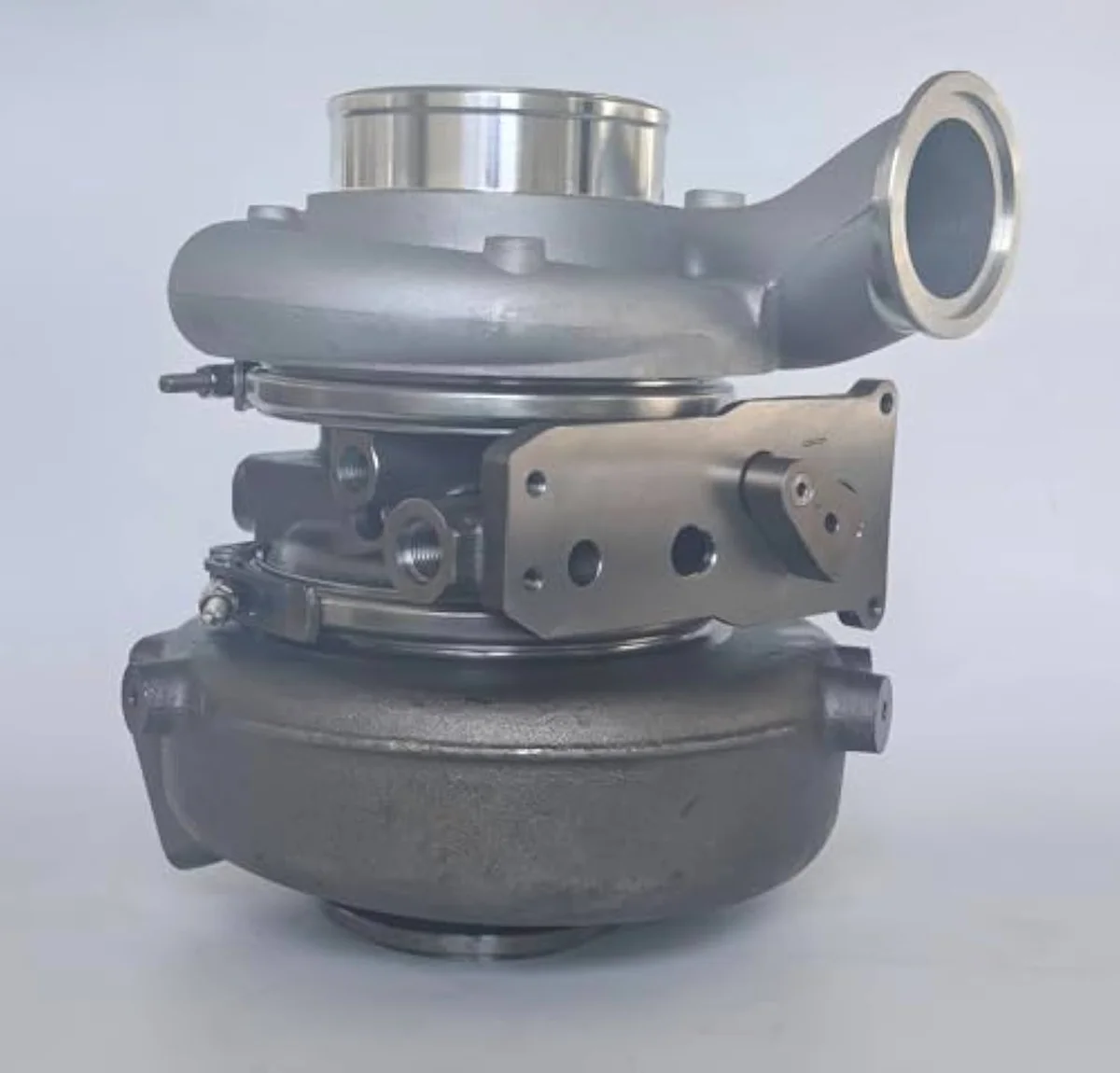
Modern turbochargers split into six documented architectural variants: fixed-geometry, variable-geometry (VGT), twin-scroll, sequential, electric (e-turbo), and compound. Each variant maps to specific applications across passenger gasoline, passenger diesel, heavy-duty pickup, industrial diesel, commercial truck, and motorsport. The six variants share a common four-component architecture — compressor wheel, turbine wheel, center cartridge (CHRA), and actuator — but differ in boost-control mechanism and airflow envelope. Per Wikipedia, total global turbocharger production exceeded 50 million units annually in 2024 across all variant families.
Definitions
Turbocharger is a forced-induction compressor driven by engine exhaust gas energy that compresses intake air to deliver higher oxygen mass per combustion cycle, allowing more fuel per cycle and producing more horsepower per liter of engine displacement than naturally-aspirated equivalents.
- Fixed-geometry turbocharger
- Fixed-geometry is the simplest variant — turbine housing geometry remains constant. Boost is controlled by a wastegate. Examples: Holset HX35 (Cummins 5.9L), BorgWarner S400 (commercial truck), Garrett GT2871R (aftermarket performance).
- Variable-geometry turbocharger (VGT)
- VGT is a variant where turbine housing inlet area changes via moveable vanes. Eliminates the wastegate, broadens usable boost band. Examples: Garrett GT1446V (Cruze 1.4L), Holset HE351VE (Cummins 6.7L 2007.5-2012), Holset HE300VG (Cummins 6.7L 2013-2025), Garrett GT3782VAS (Ford 6.7L Power Stroke).
- Twin-scroll turbocharger
- Twin-scroll is a fixed-geometry variant where the turbine housing has two separate exhaust gas inlet scrolls, fed by cylinder groups by firing order. Reduces lag, broadens torque. Examples: BMW N20 / N55 / B58, Ford 2.3L EcoBoost Mustang, Subaru WRX 2015+, Hyundai 2.0T / 2.5T.
- Sequential turbocharger
- Sequential is a multi-turbo system — one small turbo handles low-RPM boost, a larger turbo handles high-RPM boost, with a switching valve between them. Examples: Mazda RX-7 13B-REW, Subaru Legacy GT-B, modern BMW X3 / X4 M40d compound diesel.
- Electric turbocharger (e-turbo)
- Electric turbocharger is a hybrid variant — an electric motor on the shaft eliminates lag by spinning the compressor before exhaust spools it. Examples: Formula 1 (since 2014), Mercedes-AMG (M139 / M256), Audi RS, Porsche 911 Turbo S.
- Compound turbocharger system
- Compound system is a two-stage architecture — one turbo feeds a second, larger turbo in series, producing very high boost (50+ psi) at very high airflow. Examples: drag-race diesel builds, Cummins ISX, Detroit DD15, Volvo D13.
- Wastegate
- Wastegate is the boost-control valve on fixed-geometry and twin-scroll turbos that bypasses excess exhaust gas. Internal (in turbine housing) or external (separate plumbing). Pneumatic or electronic actuator.
- Compressor map
- Compressor map is the documented airflow-vs-pressure-ratio chart published per frame by Garrett, BorgWarner, Holset. Defines operating envelope between surge line and choke line plus efficiency islands.
- Frame size standards
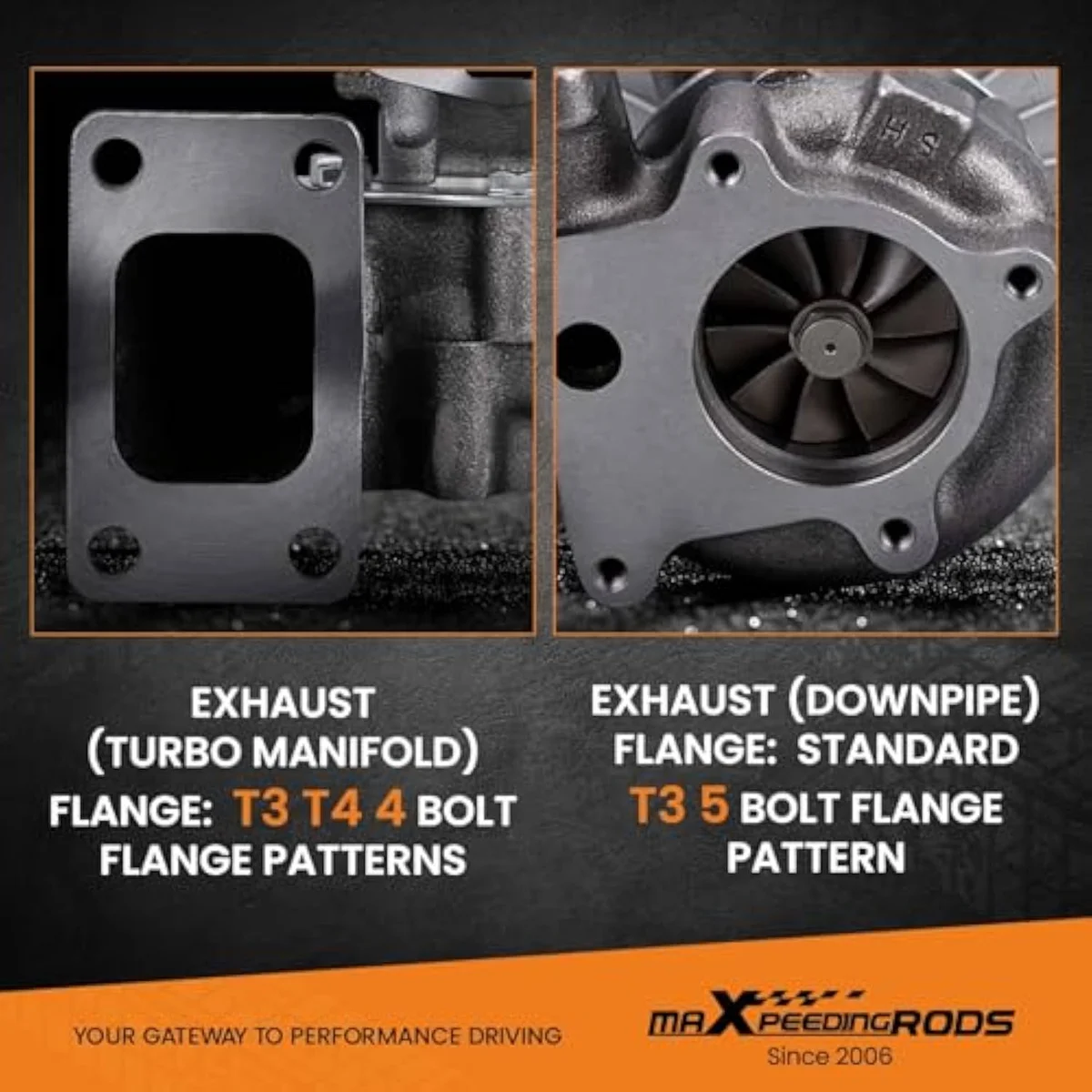
- Frame size is the universal-mount turbo flange and rotating-assembly geometry standard. T3 fits 1.6-2.4L (200-450 hp). T4 fits 2.0-4.0L (400-700 hp). GT35 fits 2.0-3.0L (450-650 hp). GT45 fits 3.0-6.0L (600-800 hp).
- A/R ratio
- A/R ratio refers to the area-over-radius ratio of the turbine housing scroll. Smaller A/R is faster spool, lower peak airflow. Larger A/R is slower spool, higher peak airflow. Per Garrett Motion, A/R sizing is the primary turbine-side selection variable.
- Inducer / exducer
- Inducer refers to the inlet wheel diameter and exducer refers to the outlet wheel diameter on compressor and turbine wheels. Inducer × exducer drives the airflow envelope.

Variant-to-Application Cross-Reference
| Variant | Primary application | Typical OE supplier | Cost band (OEM-rebuilt) | Service life |
|---|---|---|---|---|
| Fixed-geometry | Industrial diesel, commercial truck, aftermarket performance | Holset, BorgWarner, Garrett | $700-$2,500 | 300,000-1,200,000 mi |
| Variable-geometry (VGT) | Passenger diesel, heavy-duty pickup, Class-8 truck | Garrett, Holset, BorgWarner | $1,500-$3,500 | 100,000-180,000 mi |
| Twin-scroll | Modern passenger gasoline performance | BorgWarner, Mitsubishi, IHI | $800-$2,200 | 120,000-200,000 mi |
| Sequential | High-output performance, Mazda rotary, modern BMW M-series | Hitachi, BorgWarner, Mitsubishi | $2,500-$5,500 | 100,000-150,000 mi |
| Electric (e-turbo) | Mild-hybrid premium passenger, Formula 1, Mercedes-AMG | Garrett, BorgWarner, Honeywell legacy | $3,500-$8,500 | Unknown — first production 2020 |
| Compound | Drag-race diesel, Class-8 commercial truck | Custom + OEM combinations | $5,000-$15,000 | 200,000-500,000 mi (commercial) |
Universal Frame-Size Geometry Reference
| Frame | Compressor inducer | Compressor exducer | Turbine inducer | Turbine exducer | Flange | HP band |
|---|---|---|---|---|---|---|
| T3 GT2871R | 54mm | 71mm | 62mm | 53mm | T3 | 350-475 |
| T3 GT3071R | 57mm | 71mm | 68mm | 62mm | T3 | 450-575 |
| T4 GT3076R | 58mm | 76mm | 68mm | 62mm | T3/T4 | 500-650 |
| T4 GT3582R | 62mm | 82mm | 71mm | 68mm | T4 | 600-800 |
| T4 GT4202R | 72mm | 92mm | 76mm | 72mm | T4 | 800-1,000 |
| T4 GT45 | 67mm | 76mm | 72mm | 67mm | T4 | 600-800 |
Failure Modes by Variant
| Variant | Dominant failure mode | Diagnostic code | Cost to repair |
|---|---|---|---|
| Fixed-geometry | Center bearing failure, compressor wheel ingestion, wastegate actuator failure | P0299 under-boost, P0234 over-boost | $700-$2,500 |
| Variable-geometry (VGT) | Vane carbon buildup, electronic actuator failure, position sensor drift | P003A, P004A, P132B, P00AF | $200-$2,500 (stage-dependent) |
| Twin-scroll | Center bearing failure, wastegate actuator failure, divider wall cracking | P0299, P0234 | $800-$2,200 |
| Sequential | Switching valve failure, secondary turbo bearing failure, ECM coordination errors | P0299, P2261, P2262 | $2,500-$5,500 |
| Electric (e-turbo) | Electric motor failure, 48V system fault, ECM coordination errors | P0AA6, P0560, P0299 | $3,500-$8,500 |
| Compound | Inter-stage plumbing leaks, intercooler failure, stage-2 turbo overspeed | P0299, P0237, P0238 | $5,000-$15,000 |
OEM Supplier-to-Application Mapping
| OEM supplier | Headquarters | Primary OE applications | Aftermarket performance line |
|---|---|---|---|
| Garrett Motion | Plymouth, Michigan | Cruze 1.4L, Ford 6.7L Power Stroke, BMW N47, Mercedes OM651, VW TDI, Jaguar AJ200D | GT, GTX, G-series (200-1,500 hp) |
| BorgWarner | Auburn Hills, Michigan | Ford EcoBoost K03 / K04, Audi 1.8T / 2.0T, Subaru WRX 2002-2014, Volvo, BMW M3 / M4 | EFR (500-1,000 hp), S-series industrial |
| Holset (Cummins) | Huddersfield, UK | Cummins 5.9L HX35, Cummins 6.7L HE351VE / HE300VG, Cummins ISL / ISM / ISX, Volvo D12 HX52 | HX-series, HE-series rebuild |
| IHI Corporation | Tokyo, Japan | Subaru WRX / STI VF-series, BMW B47 / B57, Mercedes OM651 / AMG M177 K07, Mitsubishi Evo | RHF series, IHI Performance |
| Honeywell legacy | Morris Plains, NJ | Pre-2018 Garrett industrial applications, current aerospace + industrial | Discontinued — spun out Garrett 2018 |
| Mitsubishi Heavy Industries | Tokyo, Japan | Hyundai 2.0T / 2.5T, Lancer Evolution OEM, Dodge SRT-4, select Caterpillar industrial | TD-series, TF-series |
Component Architecture — Universal Four-Element Structure
- Compressor wheel + housing (cold side)
- The compressor wheel is a centrifugal pump that draws ambient air through the inlet and accelerates it radially into the housing volute. Modern compressor wheels are CNC-machined from billet aluminum (premium tier) or investment-cast aluminum alloy (OEM and entry tier). Per Wikipedia, compressor wheel diameter ranges from 36mm on small-frame passenger applications to 110mm+ on industrial heavy-duty frames.
- Turbine wheel + housing (hot side)
- The turbine wheel is the exhaust-driven component that converts exhaust gas energy into rotational force on the shared shaft. Turbine wheels are investment-cast from Inconel 713C or MAR-M247 nickel-superalloy because hot-side temperatures (up to 950°C continuous, 1050°C peak) exceed the melting point of conventional aluminum or steel alloys. Per Turbo University, turbine wheel balance discipline is the dominant rebuild quality factor.
- Center cartridge (CHRA)
- The CHRA (Center Housing and Rotating Assembly) joins the compressor and turbine wheels via a common shaft running through fluid-dynamic journal bearings or angular-contact ceramic ball bearings. Journal bearings are the OEM standard; ball bearings appear on premium aftermarket performance lines (Garrett GTX, BorgWarner EFR, Precision PT-series).
- Actuator (wastegate or VGT)
- The actuator controls boost pressure. Wastegate actuators (fixed-geometry, twin-scroll) bypass excess exhaust gas around the turbine wheel. VGT actuators rotate moveable vanes around the turbine wheel to change effective turbine-housing inlet area. Both can be pneumatic (boost-referenced diaphragm) or electronic (ECM-controlled servo motor) per the Cummins Turbo Technologies technical library.
Turbocharger Evolution Timeline — Documented Milestones
- 1905: Alfred Büchi files first turbocharger patent in Switzerland — fixed-geometry exhaust-driven compressor.
- 1925: First production turbocharged engine — Vulcan diesel marine engine.
- 1962-1963: First production turbocharged passenger cars — Oldsmobile Jetfire and Chevrolet Corvair Monza.
- 1978: Mercedes-Benz introduces first turbocharged diesel passenger car (300SD W116).
- 1989: Saab introduces first variable-geometry turbocharger on production gasoline engine (Saab 9000 Aero — Garrett T25-VGT).
- 1990s: VGT proliferates across European passenger diesel — Volkswagen TDI, BMW, Mercedes — using Garrett VNT (variable-nozzle turbine) technology.
- 2007.5: Cummins 6.7L Ram pickup launches with Holset HE351VE VGT — first US passenger application of heavy-duty VGT.
- 2009: Garrett introduces GTX ball-bearing performance line with billet compressor wheels — premium aftermarket tier.
- 2014: Formula 1 mandates hybrid power units with mandatory MGU-H (electric turbo motor-generator).
- 2018: Garrett introduces G-series performance line with target-horsepower naming convention.
- 2020-2025: Production e-turbo deployment expands — Mercedes-AMG M139 / M256, Audi RS, Porsche 911 Turbo S.
Application Discipline Across the Six Variants
- Fixed-geometry
- Dominates industrial diesel — constant-load duty cycle, narrow operating envelope. Per Turbo University, the broader boost band VGT delivers offers no advantage at near-constant operating points.
- Variable-geometry (VGT)
- Dominates passenger and heavy-duty diesel — road-driven duty cycles span 800 RPM idle to 4,200 RPM redline. Per the Wikipedia VGT reference, the moveable vanes deliver usable boost across the entire range that fixed-geometry cannot match.
- Twin-scroll
- Dominates modern passenger gasoline — gasoline engines need fast spool plus broad torque. The dual-scroll architecture separates exhaust pulses by firing order, preventing destructive interference per the Wikipedia twin-scroll reference. Cross-attribution from BorgWarner and Garrett shows twin-scroll displaced single-scroll fixed-geometry across nearly all 2015-and-later passenger gasoline applications under 3.0L.
- Sequential
- Persists in niche applications — Mazda rotary RX-7, BMW M-series compound-sequential setups, Subaru Legacy GT-B. Architectural complexity routinely exceeds marginal performance gain over twin-scroll plus electronic boost control.
- Electric (e-turbo)
- Architectural pivot point for the next decade. The 48V mild-hybrid electrical architecture (standard across Mercedes, BMW, Audi, Volvo) is the structural enabler for production e-turbo deployment per the Wikipedia e-turbo reference. Garrett, BorgWarner, and Honeywell-legacy roadmaps target mass e-turbo deployment by 2028-2030 per SAE technical-paper analysis.
- Compound
- Remains niche — drag-race diesel builders push 2,000-3,000+ horsepower targets; Class-8 commercial truck engines use compound at the upper end of the heavy-duty diesel power band. Mechanical complexity (interstage plumbing, multiple actuators, dual intercoolers) limits adoption outside very-high-output requirements.
OEM Supplier Application Mapping
- Garrett Motion
- Cruze 1.4L (GT1446V), Ford 6.7L Power Stroke (GT3782VAS / GT3788LVA), BMW N47 / Mercedes OM651 diesel (GT2056V), Volkswagen TDI (GT1749V variants), Jaguar AJ200D. Aftermarket performance: GT, GTX, G-series.
- BorgWarner
- Ford EcoBoost K03 / K04, Audi 1.8T / 2.0T, BMW M3 / M4 S55, Subaru WRX 2002-2014. Aftermarket performance: EFR series, S400 / S500 industrial.
- Holset (Cummins)
- Cummins 5.9L HX35 (1994-2007), Cummins 6.7L HE351VE / HE300VG (2007.5-2025), Cummins ISL / ISM / ISX heavy-truck, Volvo D12 HX52 industrial. Aftermarket: HX-series, HE-series rebuild lines.
- IHI Corporation
- Subaru WRX / STI VF-series, BMW B47 / B57 diesel, Mercedes OM651 plus AMG M177 V8 K07, Mitsubishi Evolution, Hyundai/Kia 2.2 CRDi. Aftermarket: RHF-series.
- Mitsubishi Heavy Industries
- Hyundai 2.0T / 2.5T, Lancer Evolution OEM (TD05 variants), Dodge SRT-4 (TD04), select Caterpillar industrial applications. Aftermarket: TD-series, TF-series.
Cross-attribution from SAE technical papers shows OEM supplier selection follows application engineering requirements rather than brand preference — Ford uses Garrett on Power Stroke diesel and BorgWarner on EcoBoost gasoline based on per-application engineering match. The same per-application discipline appears across Mercedes, BMW, and Volkswagen Group passenger lineups per the ADP Distributors OE manifest catalog.
Methodology
Methodology
This taxonomy synthesizes documented engineering data from manufacturer technical libraries (Garrett Motion, BorgWarner, Cummins/Holset), peer-reviewed SAE International technical papers on forced induction architecture, the Wikipedia turbocharger and variable-geometry-turbocharger reference articles, and industrial rebuilder discipline published by Turbo University (TS Reman) and the ADP Distributors turbocharger rebuilding distribution catalog. Cross-attribution between manufacturer technical libraries verifies variant-to-application mapping; multiple-source attribution prevents reliance on any single OEM's marketing framing. Frame-size geometry values come from Garrett Motion's published compressor map atlas. Failure-mode mapping follows industrial rebuilder protocols documented at TS Reman and Rotomaster. Service-life ranges aggregate fleet operator data and aftermarket rebuilder reports across documented community signal data — they are typical-range estimates, not warranty commitments.
References
References
- Turbocharger — Wikipedia. Accessed 2026-05-14.
- Variable-geometry turbocharger — Wikipedia. Accessed 2026-05-14.
- Twin-scroll turbocharger — Wikipedia. Accessed 2026-05-14.
- Electric turbocharger — Wikipedia. Accessed 2026-05-14.
- Garrett Motion technical library — Garrett Motion Inc. Accessed 2026-05-14.
- BorgWarner turbocharger product documentation — BorgWarner Inc. Accessed 2026-05-14.
- Cummins Turbo Technologies (Holset) technical library — Cummins Inc. Accessed 2026-05-14.
- Turbo University rebuilder reference — Turbo University / TS Reman. Accessed 2026-05-14.
- Turbocharger Rebuilding Distribution catalog — ADP Distributors. Accessed 2026-05-14.
- SAE International technical papers — forced induction — SAE International. Accessed 2026-05-14.
- Understanding Turbochargers Guide — Rotomaster International. Accessed 2026-05-14.