Updated
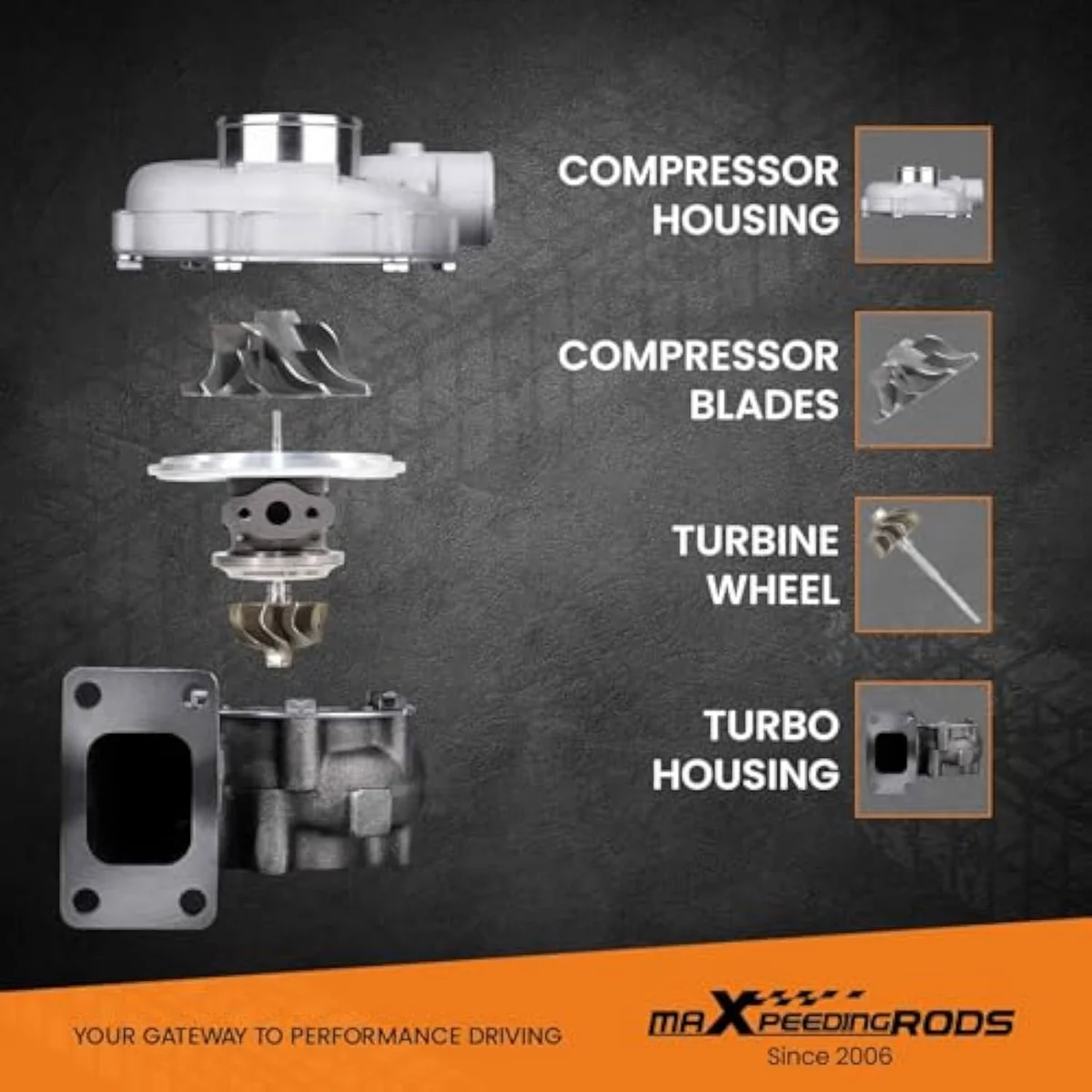
For the conventional architecture background underneath every performance turbo, see the Read the mechanism explainer — the six structural components are identical between stock OEM turbos and performance aftermarket frames; the difference is calibration, balance, and bearing type.
What Counts as a "High-Performance" Turbocharger
High-performance turbochargers occupy the 400-1,500 horsepower band that sits above OEM-replacement spec (where the OE Garrett GT1446V on a Cruze 1.4L lives at 138 hp) and below dedicated drag-race-only architectures (Owen Developments PowerMax, BorgWarner S488, custom billet-housing builds beyond 2,000 hp).
The performance tier carries four documented differences from OEM-replacement turbos. Higher peak boost calibration (25-45 psi versus 15-22 psi OEM). Ball-bearing cartridge options on every frame (OEM mostly ships journal-bearing). Billet compressor wheels (OEM mostly ships cast aluminum). ISO-grade balance certificates per shaft (OEM ships tight-but-not-racing balance). Performance turbos can survive on stock engines but rarely make use of their full output without supporting fuel-system, internals, and engine-management upgrades. Bolting a Garrett GTX3076R onto a stock 2.0-liter EcoBoost gains roughly 80-120 horsepower without any other modifications; the same turbo on a built engine with race fuel, larger injectors, and a standalone ECM gains 250-350 horsepower.
"The Precision 6266 is the default answer on every B-series Honda build that wants legitimate dyno-proven 600 horsepower on pump gas. The GTX3076R is the default answer on every Mitsubishi 4G63 build wanting the same number with faster transient response. Both have been the right answer for over a decade." — r/Honda + r/Mitsubishi synthesis on the dominant performance-frame picks across two of the most-fitted import build platforms.
The Three-Brand Dominance in the 400-1,000 HP Band
Three brands dominate the 400-1,000 horsepower performance lane with comparable engineering depth: Garrett, Precision, and BorgWarner. Each carries its own dominance pattern by build community and frame-size availability.
Garrett (broadest catalog). Three lines cover 200-2,000+ horsepower: legacy GT (journal-bearing performance, GT2871R / GT3071R / GT3076R / GT3582R workhorses of the 2000s import build era), GTX (ball-bearing premium, 2009+, GTX2867R / GTX3071R / GTX3076R / GTX3582R / GTX4202R), and current G-series (2018+, G25-550 / G30-660 / G35-900 / G42-1200 / G45-1500 named for target horsepower at peak efficiency). Garrett also has the densest OEM-aftermarket cross-reference network, making it the closest cross-shop when an OEM-Garrett application wants a step-up frame at the same flange pattern.
Precision Turbo and Engine (performance-lane focus). PT-series frames cover 350-1,400 horsepower: PT5862 (350-500 hp on 2.0-2.4L), PT6266 (500-700 hp on 2.0-2.4L — highest-volume Precision frame across import builds), PT6766 (700-900 hp on 2.4-3.0L), PT7666 (900-1,400 hp drag-race). Garrett OEM compressor wheels with in-house machining and balance discipline. Closer per-build documentation than Garrett aftermarket because Precision distribution runs through performance-shop networks with deep tuning support.
BorgWarner EFR (ball-bearing + twin-scroll specialist). EFR (Engineered for Racing) series: EFR-6258 (350-450 hp), EFR-6758 (400-550 hp), EFR-7163 (500-700 hp), EFR-7670 (650-850 hp), EFR-8374 (800-1,000 hp), EFR-9180 (1,000+ hp drag-race). All ball-bearing as standard, all twin-scroll inlet options. BorgWarner publishes deeper compressor-map data than any other brand on the 500-900 horsepower band, and the twin-scroll inlet eliminates exhaust pulse interference at low RPM for faster spool than equivalent single-scroll frames.
Frame-Size Matching to Build Target
Three inputs drive every frame-size decision: engine displacement, target horsepower at peak, and the required RPM band where peak power is needed. The exercise plots those values on the manufacturer\'s published compressor map and looks for the smallest frame that fits the airflow target inside the efficiency island.
Worked example: 2.0-liter engine targeting 500 horsepower at 6,500 RPM, pump gas. Required mass airflow at peak: roughly 50-55 lb/min. Required pressure ratio: 2.4-2.6 (about 21-22 psi of boost). On the Garrett GTX3071R compressor map, that operating point sits inside the 75% efficiency island. On the Precision PT5862, the same point sits inside the 76% island. Both frames fit; either is correct. Step up to 700 horsepower at 7,000 RPM and the operating point moves toward 70-75 lb/min and pressure ratio 2.8-3.0 — past the efficiency island on the smaller frames. The larger Garrett GTX3076R or Precision PT6266 holds peak efficiency at the new operating point.
Frame undersizing destroys the build. A frame too small for the target chokes the airflow above the spool-up RPM, capping peak horsepower below the goal regardless of boost target. The buyer sees the compressor map\'s choke line approach at the target RPM and pressure ratio; pushing past it damages the impeller wheel at supersonic tip speeds. Frame oversizing kills driveability. A frame too large for the engine takes 1,500-2,000 RPM longer to spool than necessary, leaving the engine in lag pocket through most street driving. The right frame fits the airflow target with margin on both ends of the operating range.
Bolt-On Kits vs Custom Fabrication Paths
The build path splits into two formats. Bolt-on kits target a specific chassis-and-engine combination with chassis-matched exhaust manifold, downpipe, intercooler, and intake plumbing. Custom-fab builds target a universal-flange turbo (T3 / T4 / GT45 format) with buyer-fabricated exhaust manifold, custom intake plumbing, and standalone engine management.
Bolt-on kits dominate the high-volume platforms with mature aftermarket support: Honda B-series / K-series, Mitsubishi 4G63, Subaru EJ257 / FA20, Nissan SR20 / RB / VR38, GM LS, Ford 5.0L Coyote / 2.3L EcoBoost, Hemi 5.7L / 6.4L. Kit prices from established vendors (BorgWarner EFR kits via Full-Race / RPF / TiAL distributors, Garrett kits via DSPort / FFP, Precision kits via Performance Turbo / Forced Performance) run $4,000-$15,000 for the complete kit plus install. The kit includes exhaust manifold, turbo, wastegate (often external), downpipe, intercooler core, charge piping, and fuel-system upgrade in most cases.
Custom-fab builds dominate the platforms without mature kit support: less-common imports, vintage builds, and any engine swap into a non-standard chassis. The buyer starts with a universal-flange turbo ($300-$3,500 depending on brand and frame), fabricates the exhaust manifold (or buys a universal log-style), pieces together the intercooler and charge plumbing, and writes the tune from scratch on a standalone ECM. Total build time runs 40-200 hours of fab work plus parts; total cost runs $6,000-$20,000+ depending on the standard of execution. The right format depends on whether the buyer\'s chassis has mature bolt-on kit support.
For the Garrett-side brand-tier deep dive, the Read the Garrett brand-tier guide covers GT, GTX, and G-series performance lines plus OEM cross-reference patterns. For the Precision-side equivalent, the Read the Precision Turbo brand-tier guide covers PT-series frame sizes and the journal vs ball-bearing decision. For the universal-flange budget-tier path, the Read the Maxpeedingrods T3/T4 review covers the entry-tier custom-fab format. For the cross-engine cross-shop, the Read the cross-engine roundup covers documented OE-replacement and performance picks across multiple chassis lanes.
For the deeper engineering background, the Turbocharger reference covers the architectural fundamentals. The Garrett Motion technical library publishes the GT / GTX / G-series compressor maps. The Turbo University reference publishes industrial-tier balance-and-test discipline. The Turbocharger Rebuilding Distribution catalog publishes the OE manifest network.
Performance Turbo Decision Questions
- What is the most powerful turbocharger on the market?
- For single-turbo production-aftermarket applications, the Garrett G45-1500 covers 1,500 horsepower targets and the Precision PT7666 covers similar peak on drag-race-only duty cycles. For dual-turbo applications on V8 platforms (Ford 5.0L Coyote, GM LS, Hemi 6.2L), twin GTX4202R or twin G35-900 frames cover 1,400-1,800 horsepower at peak boost. Beyond 1,800 horsepower the architecture shifts to dedicated racing turbos from Owen Developments, BorgWarner S400-series, or custom-spec billet-housing builds.
- What is the best turbocharger brand for performance?
- Three brands dominate the 400-1,500 horsepower performance lane with comparable engineering depth. Garrett (broadest catalog: GT, GTX, G-series across 200-2,000+ hp ratings with the densest OEM cross-reference network). Precision Turbo and Engine (focused on the performance lane, closer per-build documentation, Garrett castings with in-house machining). BorgWarner EFR (ball-bearing only, twin-scroll inlet options, deepest documentation on the 500-900 hp band). Below 400 hp the cross-shop opens to OEM-aftermarket; above 1,500 hp it narrows to drag-race specialty builders.
- How does compressor-map matching work?
- Three inputs determine the frame-size match: engine displacement (in liters), target horsepower at peak, and required RPM band (where the build needs to make peak power). The exercise plots those values on the manufacturer's published compressor map for each candidate frame and looks for the smallest frame that fits the airflow target inside the efficiency island. A 2.0-liter engine making 500 horsepower at 6,500 RPM fits a Garrett GTX3071R or Precision PT5862; same engine at 700 horsepower at 7,000 RPM steps up to a GTX3076R or PT6266.
- What is the difference between journal-bearing and ball-bearing turbos?
- Journal-bearing cartridges use fluid-dynamic bearings — engine oil under pressure forms a hydrodynamic film between the shaft and bearing housing. Spool: 400-800 RPM slower than ball-bearing equivalents on the same frame. Cost: baseline. Right for road builds and cruise-and-tow heavy-duty applications. Ball-bearing cartridges use angular-contact ceramic balls with grease pre-pack plus oil-mist lubrication. Spool: 15-25% faster. Cost: +$300-$700 per turbo. Right for road race, drag race, and any application where transient throttle response matters more than per-dollar performance.
- How much boost is too much for a performance turbo?
- Peak boost is bounded by three constraints: the compressor map (running past the surge or choke line damages the wheel), the engine's structural margin (factory pistons, rods, and head gaskets fail at specific cylinder pressures), and the fuel system's mass-flow capacity (a 2,000 cc/min injector at 60% duty cycle caps the engine at roughly 600 horsepower regardless of boost). Modern OEM applications run 15-22 psi; performance aftermarket builds run 25-45 psi; drag-race applications run 50+ psi at the cost of dramatically shortened engine life. The right boost target is the lowest pressure that hits the horsepower goal inside all three constraints.
- Are universal performance turbos worth it?
- For builds where the buyer is fabricating the exhaust manifold and intake plumbing from scratch, yes — universal performance turbos (T3 / T4 / GT45 frame format, V-band downpipe options) give the buyer flexibility on flange geometry and frame-size sizing. For OE-chassis replacement work, no — universal kits require custom flange fabrication that does not match factory exhaust manifolds, turning a 4-hour swap into a 12-hour fab exercise. The decision depends on whether the build is bolt-on or custom-fab.
- What is the difference between a stock turbo and a performance turbo?
- Stock OEM turbos are calibrated for OE boost targets (15-22 psi) on the OE engine's airflow envelope, ship with journal-bearing cartridges for cost and durability, and use OEM-balance discipline (tight but not racing-grade). Performance aftermarket turbos run higher peak boost (25-45 psi), often ship with ball-bearing cartridges for response, use billet compressor wheels for higher tip-speed tolerance, and meet drag-race or road-race balance specifications (ISO-grade balance certificates per shaft). Performance turbos can survive on stock engines but rarely make use of their full output without fuel system, internals, and management upgrades.
Get Product Updates
Updates only when something changes.
Only when something changes. Unsubscribe anytime.