Updated
For the opposite end of the frame-size catalog, see the Read the big turbochargers guide — covers the 76mm+ inducer single-turbo category for 800-2,000+ hp applications.
What Counts as a "Small" Turbocharger
"Small" turbochargers in aftermarket performance terms occupy the 38-48mm compressor inducer category, below the entry-tier T3/T4 universal performance frames at 50-60mm inducer. The size threshold correlates with peak airflow capacity (typically 5-25 lb/min) and target horsepower band (typically 30-250 horsepower depending on the specific frame).
The small-turbo category serves three distinct buyer applications. OEM 1.0-1.6L passenger-car displacement (Ford EcoBoost 1.0L on Fiesta, GM 1.4L Ecotec on Cruze / Sonic / Trax / Buick Encore, VW 1.4 TSI, Honda 1.5L L15B7 on Civic / CR-V / Accord). Motorcycle turbo conversion (aftermarket builds on Honda CBR / Suzuki Hayabusa / Kawasaki ZX / Yamaha YZF using small-frame turbos sized to motorcycle airflow envelopes). Small-engine industrial retrofit (snowmobile turbo conversions, ATV turbo retrofits, lawn-equipment turbocharging on 200-800cc engines).
"The Maxpeedingrods VZ21 RHB31 is the default motorcycle turbo conversion turbo for Hayabusa and CBR builds. $150-$300 entry-tier price, IHI RHB31-class frame format, journal-bearing standard, suitable for 250-350 horsepower from 1,000-1,300cc base engines. The premium tier Garrett or IHI direct equivalent costs $600-$1,200 and offers slightly tighter balance discipline." — r/motorcycle / r/Hayabusa synthesis on the entry-tier motorcycle-turbo conversion build market.
Dominant Small-Frame Families
Three OEM-supplier brand families dominate the small-frame turbocharger category. IHI RHB31 / RHB32 / RHF3 series covers 25-130 horsepower applications, predominantly Japanese OEM and motorcycle-conversion. Garrett GT12 / GT1241 / GT1748 series covers 60-250 horsepower applications, predominantly European OEM (BMW, Mercedes, VW Audi). BorgWarner KP31 / KP35 / KP39 series covers 100-200 horsepower applications, predominantly Ford EcoBoost 1.0L / 1.6L OEM.
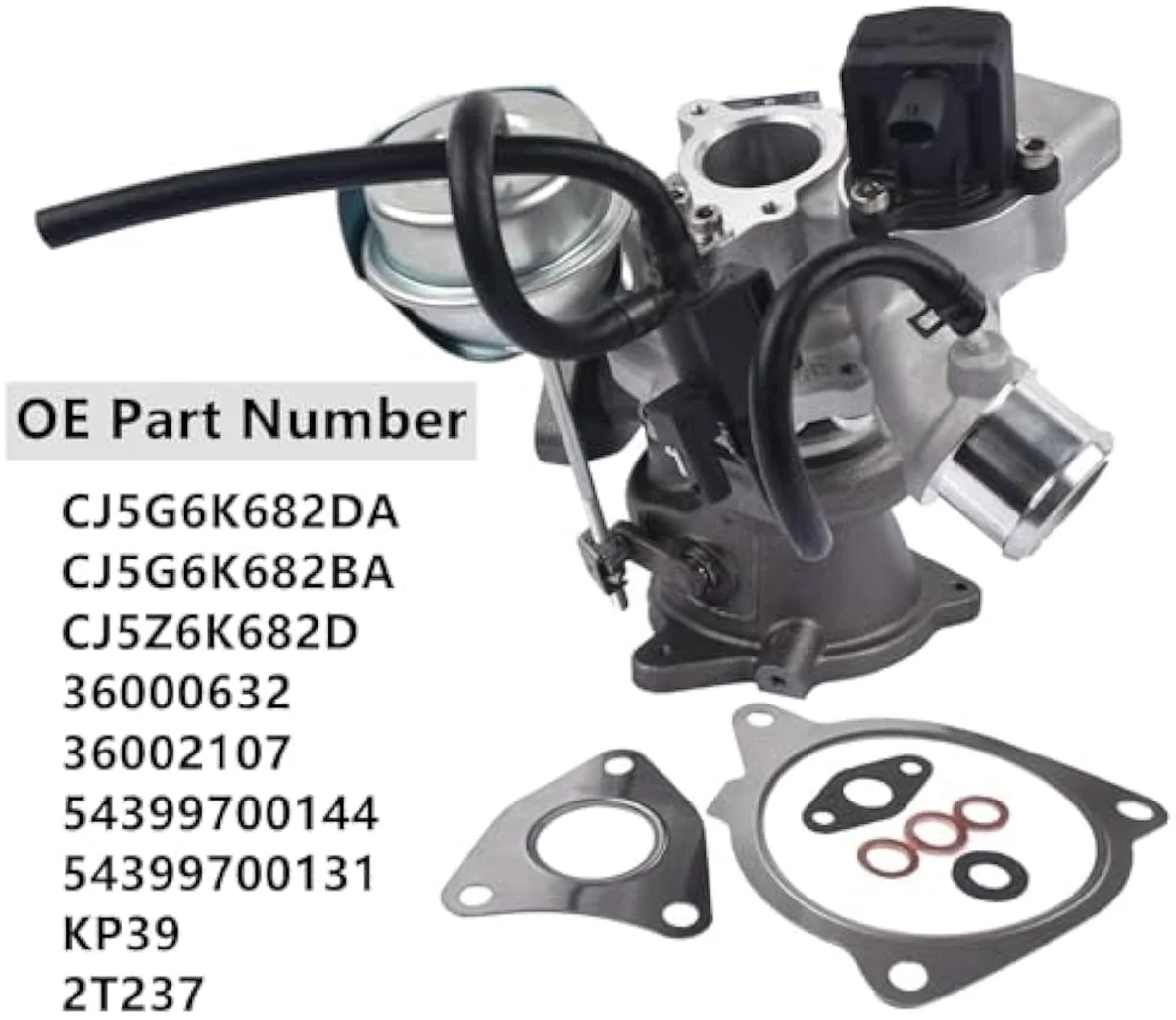
Application-specific cross-reference. Ford EcoBoost 1.0L Fiesta → BorgWarner KP31 OEM (aftermarket cross: budget-tier Chinese KP31 cross-references at $150-$400). Ford EcoBoost 1.6L Escape / Fusion → BorgWarner KP39 OEM (budget cross-reference: KP39 1.6L universal at $200-$500). GM 1.4L Cruze / Sonic / Trax → Garrett GT1446V (covered in dedicated Cruze cross-reference content). VW 1.4 TSI → Garrett KP39 or BorgWarner cross-references depending on model year. Honda 1.5L L15B7 → various small-frame Mitsubishi or Honeywell sources depending on application generation.
Frame-Size Matching at the Small End
Picking a small turbocharger requires the same frame-size matching exercise as picking a big turbocharger: engine displacement, target horsepower at peak, and the required RPM band where peak power is needed. For small turbos the math typically lands in 5-25 lb/min mass airflow at peak with pressure ratio 1.6-2.5 (about 9-22 psi of boost).
Worked example: 1.0L 3-cylinder targeting 200 horsepower at 6,500 RPM. Required mass airflow at peak: roughly 20-22 lb/min. Required pressure ratio: 2.4 (about 21 psi of boost). On the IHI RHF3 compressor map, that operating point sits inside the 73% efficiency island; on the Garrett GT1748 it sits inside the 75% island. Either frame fits cleanly; the IHI wins on documented OEM availability for Ford EcoBoost 1.0L applications. Worked example for motorcycle conversion: 1,300cc 4-cylinder targeting 350 horsepower at 11,000 RPM. Required mass airflow: roughly 25 lb/min. Required pressure ratio: 2.0. On the IHI RHB31 compressor map, the operating point sits at the choke line limit; on the Garrett GT12 it sits inside the efficiency island. Garrett wins on this application.
Aftermarket Small-Turbo Cross-Shop
For aftermarket performance buyers on small-engine applications, the catalog splits between budget-tier Chinese cross-references and premium OEM-direct sourcing. The decision flips on application context similar to other turbo tiers.
Budget tier: Maxpeedingrods VZ21 RHB31 at $150-$300, generic Chinese KP31/KP39 cross-references at $150-$400, Autobaba / Donpida / Filterup 1.4L Cruze cross-references at $150-$300. Budget-tier service life on daily-driver applications: 30,000-80,000 miles. Premium tier: OEM Garrett GT1241 / GT1748 direct, OEM BorgWarner KP31 / KP39 direct, OEM IHI RHB31 / RHF3 direct at $500-$1,200. Premium tier service life on daily-driver applications: 100,000-180,000 miles. The 4-5× price gap maps to a 2-3× service life gap, similar to the cross-shop pattern at other frame sizes.
Motorcycle and Small-Engine Conversion Applications
Aftermarket motorcycle turbo conversion kits represent the largest non-OEM small-turbo application segment. Honda CBR / Hayabusa-class displacement (1,000-1,300cc) covers most documented motorcycle conversion builds. The kits typically include a small-frame turbo (IHI RHB31, Garrett GT12, or Maxpeedingrods VZ21 budget cross-reference), custom-fabricated exhaust manifold, intake plumbing, wastegate, intercooler, and fuel-system upgrade hardware.
Documented motorcycle turbo build power targets. Honda CBR1000 baseline 180 hp → 280-320 hp turbocharged on stock displacement. Suzuki Hayabusa 1300cc baseline 195 hp → 350-450 hp turbocharged. Kawasaki ZX-14R baseline 200 hp → 320-400 hp turbocharged. Snowmobile turbo retrofits on 600-900cc 2-stroke and 4-stroke engines reach 200-280 hp from baselines around 130-180 hp. The percentage gain dwarfs anything achievable on a V8 turbo build, which is what keeps the motorcycle conversion segment active despite the budget tier\'s limited service life.
For the broader frame-size catalog context, the Read the high-performance turbocharger guide covers Garrett, Precision, and BorgWarner with frame-size matching exercises across the full catalog. For the opposite frame-size end, the Read the big turbochargers guide covers the 76mm+ category. For the foundational mechanism background, the Read the mechanism explainer covers the six structural components that apply at every frame size. For the motorcycle-conversion application, the Read the motorcycle turbo guide covers small-frame conversion-build applications. For the budget-tier motorcycle conversion turbo product, the Read the Maxpeedingrods VZ21 RHB31 review covers the documented entry-tier pick. For the broader cross-engine roundup, the Read the cross-engine roundup covers documented OE-replacement picks.
For deeper engineering background, the Turbocharger reference covers compressor-and-turbine fundamentals applicable at every frame size. The Turbo University reference publishes industrial-tier balance-and-test discipline applicable to small-frame OEM and aftermarket cores. The Understanding Turbochargers Guide covers the rebuilder-tier protocol applied across frame sizes. The Turbocharger Rebuilding Distribution catalog publishes OE manifest cross-references including small-frame KP31, KP39, RHB31, GT1241, GT1748 cores.
Small Turbo Decision Questions
- What is considered a "small" turbocharger?
- In aftermarket performance terms, "small" usually means a 38-48mm compressor inducer — the threshold below the entry-tier T3/T4 universal performance frames at 50-60mm inducer. Small-frame applications include OEM 1.0-1.6L passenger cars (Ford EcoBoost 1.0L Fiesta, GM 1.4L Cruze, VW 1.4 TSI), motorcycle turbo conversions (650-1,200cc engines), and small-engine industrial applications (snowmobile, ATV, lawn equipment turbo retrofits).
- Are small turbos worth it?
- For small-displacement applications where adding a small turbo doubles the horsepower from 80-100 hp baseline to 180-220 hp turbocharged, yes — the percentage gain is dramatic and the supporting modifications (fuel system, intake plumbing, intercooler) are modest compared to V8 turbo builds. For larger displacement applications where a small turbo would be the wrong frame size against the engine's airflow envelope, no — picking a larger frame is structurally correct.
- What is the smallest turbocharger?
- The IHI RHB31 (31mm compressor inducer, 25-50 hp output) is among the smallest production turbochargers available, originally designed for kei-class Japanese motorcycles and small-engine applications. The IHI RHB32 / RHF3 frames cover slightly larger applications (50-100 hp). Garrett GT12 covers 60-130 hp. Below the RHB31 size threshold, the airflow becomes too small to drive a meaningful turbine wheel; very small applications use mechanical superchargers or stay naturally aspirated.
- Can a turbocharger be too small?
- Yes — picking a turbo too small for the engine displacement causes the compressor wheel to choke at the engine's peak airflow demand, capping peak horsepower regardless of boost target. A 2.0-liter engine forcing 35 psi through a Garrett GT12-class small frame produces less peak power than the same engine at 18 psi through a properly-sized Garrett GTX2867R. The frame-size matching exercise determines whether small is the right call for the application; mismatched small turbos waste tuning effort.
- What size turbo for a 1.0L engine?
- For OE-replacement on Ford EcoBoost 1.0L Fiesta or similar 1.0L applications, the factory Garrett GT1238 or BorgWarner KP31 is the right cross-reference at $400-$900. For aftermarket performance builds on a 1.0L engine targeting 200-250 horsepower, the Garrett GT1748 or IHI RHF3-class fits with margin. Below 200 horsepower the OEM frame is correct; above 250 horsepower the 1.0L block typically cannot survive the cylinder pressure regardless of frame size.
- Do motorcycles use small turbochargers?
- Yes — aftermarket motorcycle turbo conversion kits run on Honda CBR / Civic-displacement crossover engines, Suzuki Hayabusa 1300cc applications, Kawasaki ZX series, and Yamaha YZF. The conversion kits use small-frame turbos (IHI RHB31, Garrett GT12, BorgWarner KP31) sized to motorcycle airflow envelopes. Documented motorcycle turbo builds reach 250-400 horsepower from 1,000-1,300cc base engines via aftermarket conversion. The Maxpeedingrods VZ21 RHB31 is the budget-tier motorcycle conversion turbo at $150-$300.
- How long do small turbochargers last?
- OEM small turbochargers (Ford EcoBoost 1.0L, GM 1.4L Cruze, VW 1.4 TSI) routinely reach 120,000-180,000 miles when oil-change discipline holds — same service life expectation as larger OEM turbos. Motorcycle turbo conversion small frames see 30,000-60,000 miles on track-driven duty cycles; small-engine industrial applications (snowmobile, ATV) see similar service life. The wear pattern correlates with rotational stress more than absolute frame size; small turbos at high RPM see comparable bearing wear to large turbos at lower RPM.
Get Product Updates
Updates only when something changes.
Only when something changes. Unsubscribe anytime.