Updated
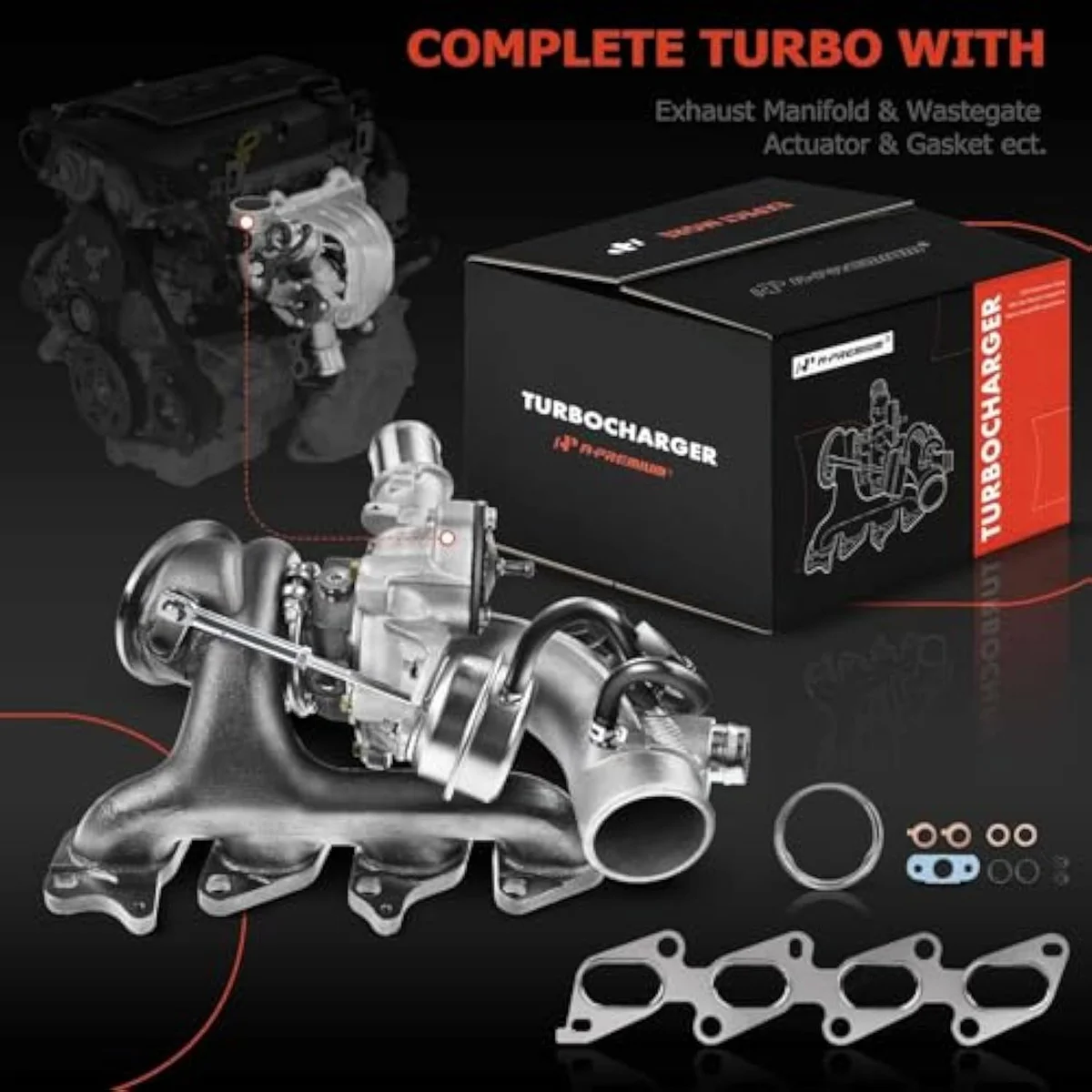
For the broader install-base map covering which production cars ship with factory turbochargers, see the Read the install-base map — covers Ford EcoBoost, GM 1.4L Ecotec, BMW N20/N55/B58, Mercedes, and the full US OEM landscape.
The Passenger-Car Turbo Market Segment
Passenger-car turbocharger applications represent the largest segment of the US automotive turbocharger market by volume — millions of units across Ford F-150 EcoBoost (2.7L V6 and 3.5L V6) plus the broader Ford EcoBoost lineup. The high-volume chassis dominate aftermarket replacement work; smaller-volume luxury and performance platforms round out the market.
Three buyer paths cross this market segment. OE-replacement on stock cars represents the highest volume — Chevy Cruze 1.4L LUJ owners with P0299 codes replacing factory turbos, Ford EcoBoost 2.0L owners replacing failed K03 frames, BMW owners replacing N20 / N55 turbos at 80,000-150,000 mile failure threshold. Brand-tier upgrade represents smaller volume — owners with healthy stock turbos opting for premium aftermarket Garrett aftermarket or BorgWarner EFR for performance gains. Aftermarket performance build represents the enthusiast segment — Honda K20 / B-series, Mitsubishi 4G63, Subaru EJ257, GM LS, Ford Coyote 5.0L turbocharger conversion kit builds at $4,000-$15,000 installed.
"The Cruze 1.4L PCV failure pattern is the documented Achilles heel of the GM 1.4L Ecotec platform. Without the PCV fix, the replacement turbo dies on the same schedule as the OEM unit — 80,000-130,000 miles. With the PCV fix done correctly, the aftermarket A-Premium / Ingkan / Filterup units routinely reach 100,000+ miles. The fix is the structural enabler of the entire aftermarket segment on this platform." — r/Cruze synthesis on the documented PCV-related root cause that governs Cruze 1.4L turbo service life.
The Highest-Volume Aftermarket Applications
Three chassis applications dominate US passenger-car turbo aftermarket replacement work: Chevy Cruze 1.4L (2011-2019), Ford EcoBoost 2.0L (2013-onward), and Cummins 6.7L diesel on Ram heavy-duty pickups.
Cruze 1.4L (2011-2019 Cruze + Sonic + Trax + Buick Encore). Ford EcoBoost 2.0L (Escape + Focus + Fusion + Taurus + Edge + Explorer + Lincoln MKC/MKT/MKZ). Cummins 6.7L diesel (Ram 2500/3500/4500/5500 — while technically a pickup truck the heavy-duty diesel install base shares the OEM-replacement buying decision pattern).
Cruze 1.4L is the highest single-chassis aftermarket volume in the US passenger-car market. Six budget-tier aftermarket cross-references compete on the OE 55565353 / 781504 / 667-203 / GT1446 cross-reference family: A-Premium, Ingkan, Filterup, Autobaba, Donpida, Tekkoauto. The cross-shop is genuinely close on price ($150-$300) and engineering depth (all journal-bearing, all 1-year warranty, all Chinese-manufactured with similar Amazon distribution).
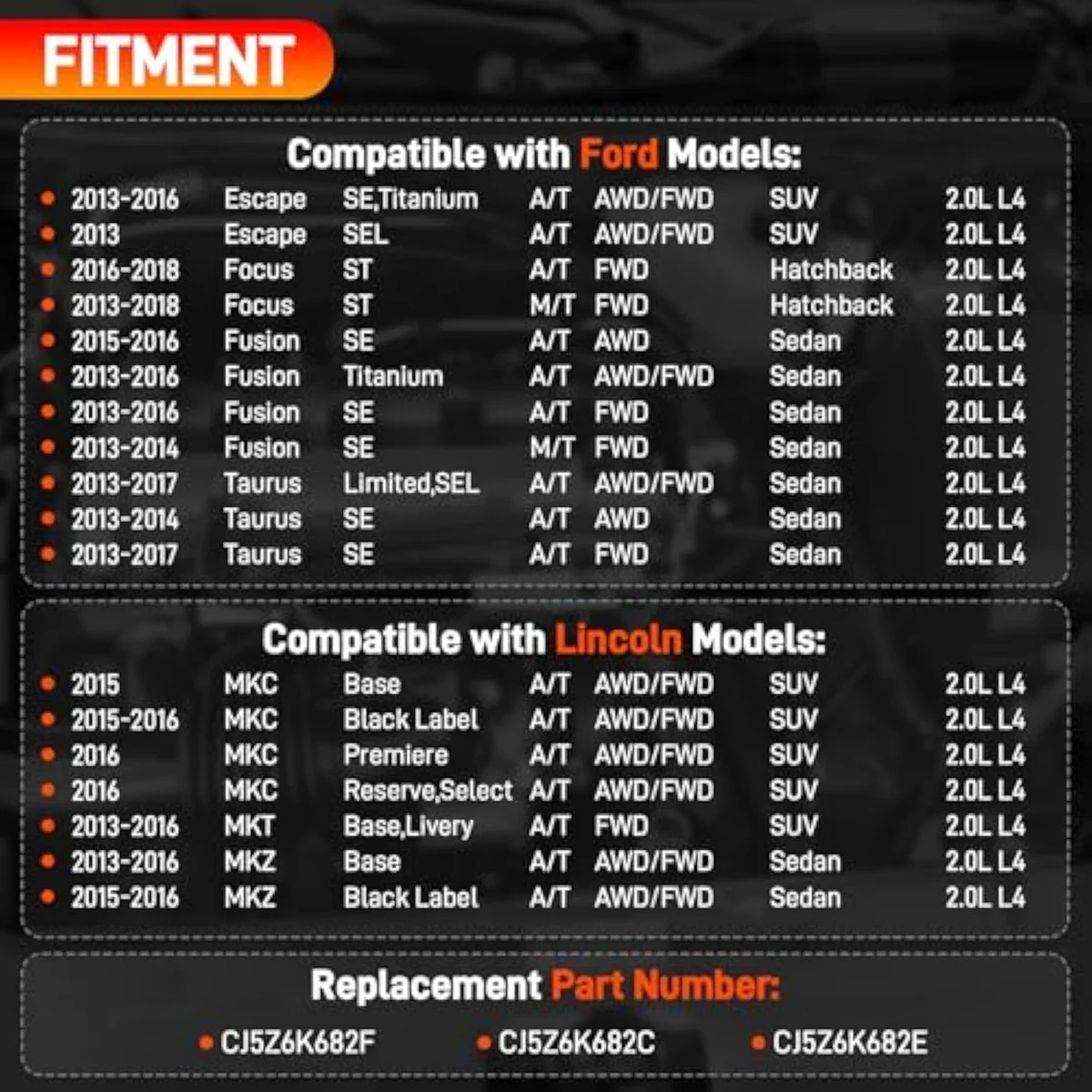
Ford EcoBoost 2.0L represents the second-highest aftermarket volume. The OE BorgWarner K03 cross-reference covers Escape (2013-2019), Focus (2013-2018), Fusion (2013-2016), Taurus (2013-2017), Edge (2015-2018), plus Lincoln MKC / MKT / MKZ variants. Aftermarket replacement options at $200-$700 budget tier through $800-$1,500 premium tier. Documented in dedicated review content covering the GDUKOP CJ5Z6K682C build quality. BMW N20 / N55 / B58 represents the third-highest aftermarket volume. OEM Mitsubishi or BorgWarner depending on generation; aftermarket replacement runs through specialty BMW-aftermarket distributors at $1,800-$3,500 typical.
The Three Buyer Paths in Detail
Three distinct buyer paths cross the passenger-car turbo aftermarket: OE-replacement on stock cars, brand-tier upgrade on healthy applications, and full aftermarket performance build with bolt-on conversion kit. Each path maps to a different price band, performance target, and supporting-mod scope.
Path 1: OE-replacement on stock cars. Buyer with a failed factory turbo facing dealer quote $1,800-$5,000. Solution: Amazon-tier aftermarket cross-reference at $150-$700 with documented OE part-number compatibility. The 5-15× savings opportunity drives the buying decision; brand tier (budget vs OEM-aftermarket) sets the service-life vs price tradeoff.
Path 2: Brand-tier upgrade on healthy applications. Buyer with a working factory turbo opting for Garrett aftermarket Stage 2 or BorgWarner EFR for performance gains. Pricing $400-$1,800 depending on brand and frame. Service life matches or slightly trails OEM; performance gain typically 30-80 horsepower over Stage 1 OEM-spec.
Path 3: Aftermarket performance build. Buyer with a target chassis (Honda B/K, Mitsubishi 4G63, Subaru EJ, GM LS, Ford Coyote, Hemi) installing a complete bolt-on turbo conversion kit. Pricing $4,000-$15,000 installed with tune for documented dyno-proven horsepower gains. Service life 40,000-100,000 miles depending on duty cycle and supporting modifications. Right for owners chasing 400-800+ horsepower on platforms where the kit market is mature; wrong for owners chasing OEM-replacement spec.
Maintenance Discipline That Extends Turbo Service Life
Three documented maintenance practices extend passenger-car turbocharger service life: oil-change cadence at 5,000-7,500 miles, PCV-system maintenance on Cruze 1.4L, and intake-valve carbon cleaning at 60,000-80,000 miles on direct-injection EcoBoost 1.6L.
The full maintenance list per chassis. Oil-change cadence at 5,000-7,500 mile intervals (manufacturer-spec synthetic oil only) across every platform. PCV-system maintenance specifically on Cruze 1.4L LUJ / LUV applications (replace PCV valve before installing replacement turbo, otherwise the new turbo dies on the same schedule). Intake-valve carbon cleaning at 60,000-80,000 mile intervals on direct-injection EcoBoost 1.6L applications.
The Cruze PCV pattern is documented in detail across r/Cruze and CruzeTalk forum threads going back to 2014. The factory PCV valve allows excessive crankcase pressure to push oil mist into the intake stream; the abrasive oil erodes the GT1446V compressor wheel at supersonic tip speeds. Without PCV replacement before turbo replacement, the new turbo fails at 80,000-130,000 miles on the same schedule as the OEM unit. With PCV replacement done at the same time, the aftermarket budget-tier replacement routinely reaches 100,000+ miles — matching the OEM cohort service life at one-tenth the cost.
For the broader install-base map covering which production cars ship with factory turbochargers, the Read the install-base map covers the full US OEM landscape. For the diagnostic decision tree on what repair path fits the buyer\'s failure mode, the Read the four-stage repair decision guide covers Clean / Actuator / Cartridge / Complete with cost bands per chassis. For the cross-engine roundup of documented aftermarket picks, the Read the cross-engine roundup covers Cruze, EcoBoost, and Cummins lanes. For the specific budget-tier Cruze 1.4L cross-reference review, the Read the A-Premium Complete kit review covers the documented install-completeness experience on the highest-volume passenger-car aftermarket application.
For deeper engineering background, the Turbocharger reference covers compressor-and-turbine fundamentals applicable to every passenger-car application. The Turbo University reference publishes industrial-tier balance-and-test discipline applicable to passenger-car OEM and aftermarket cores. The Understanding Turbochargers Guide covers the rebuilder-tier protocol shops apply across chassis. The Turbocharger Rebuilding Distribution catalog publishes OE manifest cross-references for the high-volume Cruze 1.4L, EcoBoost 2.0L, and BMW N20/N55/B58 platforms.
Car Turbo Decision Questions
- What is the best turbocharger for a car?
- The right turbocharger depends entirely on the specific car. For Cruze 1.4L LUJ/LUV applications, the OEM Garrett GT1446V or budget cross-references (A-Premium, Ingkan, Filterup) at $150-$700. For Ford EcoBoost 2.0L applications, OEM BorgWarner K03 or budget cross-references at $200-$700. For BMW N20/N55/B58 applications, OEM Mitsubishi or BorgWarner depending on generation. The "best" framing is application-specific; no single turbocharger fits every car.
- How much does it cost to replace a car turbocharger?
- Dealer pricing for OE-replacement on the highest-volume US passenger-car turbo applications: $1,800-$2,400 (Cruze 1.4L), $2,500-$3,300 (Ford EcoBoost 2.0L), $3,500-$5,000 (BMW N20/N55 with labor), $2,800-$4,500 (Audi 2.0T). Aftermarket Amazon-tier replacement runs 4-15× cheaper: $150-$700 on the same chassis depending on brand tier. The 5-15× savings opportunity drives the entire aftermarket replacement category.
- Can you put a turbocharger on any car?
- Mechanically, yes — every internal combustion engine can be turbocharged with a custom-fabricated kit. Practically, the build cost varies dramatically depending on platform aftermarket support. Honda B-series / K-series, Mitsubishi 4G63, Subaru EJ, Nissan SR/RB, GM LS, Ford 5.0L Coyote, Hemi 5.7L/6.4L have mature bolt-on kit markets ($4,000-$15,000 installed). Less-common platforms require custom fabrication ($8,000-$25,000). For OEM-replacement work, no fabrication is needed — the part just bolts on with documented cross-references.
- Are turbocharged cars worth it?
- For OEM applications since 2008, turbocharged cars deliver 15-25% better cruise fuel economy than equivalent naturally-aspirated displacement while matching or exceeding peak horsepower. The fuel-economy advantage carries through the cruise miles that dominate daily-driver duty cycles. The maintenance cost gap versus naturally aspirated equivalents is marginal — slightly higher oil-change cadence (every 5,000-7,500 miles instead of 7,500-10,000) and the turbocharger itself is a wear part with 120,000-200,000 mile expected lifespan. The math favors turbocharged for most US passenger-car buyers.
- What is the most common turbocharged car?
- Ford F-150 EcoBoost variants (2.7L V6 and 3.5L V6) are the highest-volume turbocharged vehicles in the US market, with millions of units across the F-150 install base since 2011. Chevy Cruze 1.4L (2011-2019) was the highest-volume turbocharged passenger car during its production run. Ford Escape, Edge, Explorer, Fusion EcoBoost variants share the broader Ford EcoBoost install base. BMW gas engines (every variant since 2008) and Mercedes-AMG / regular Mercedes have become almost entirely turbocharged across the lineup.
- How long does a car turbocharger last?
- Modern OEM turbochargers from Garrett, BorgWarner, Holset, Mitsubishi, and IHI suppliers on 2015-onward applications routinely reach 120,000-200,000 miles when oil-change discipline holds. The exceptions: Chevy Cruze 1.4L (PCV-related failure at 80,000-130,000 miles), Ford EcoBoost 1.6L (intake-valve carbon buildup at 60,000-80,000 miles), BMW N20 (timing-chain guide failure at 60,000-100,000 miles — not turbo-direct but related). Heavy-duty diesel turbos routinely reach 200,000-300,000 miles.
- Do all new cars have turbochargers?
- Not all, but increasingly the majority. Every modern OEM passenger-car platform that added forced induction since 2008 picked turbocharging. The remaining naturally aspirated holdouts are mostly base-trim small cars (Toyota Corolla 1.8L, Honda Civic 2.0L base, Hyundai Elantra 2.0L) and large-displacement sports cars (Corvette LT2 6.2L, Mustang GT 5.0L Coyote). High-volume mainstream models (Ford F-150, Honda CR-V, Toyota RAV4 Prime, BMW everything) ship turbocharged in most or all trim levels.
Get Product Updates
Updates only when something changes.
Only when something changes. Unsubscribe anytime.