Updated
Confirm the 1.6L EcoBoost chassis match and the CJ5G6K682 stamp prefix before clicking through, or Check Price on Amazon now.
KP39 Frame: 1.6L EcoBoost Lane
Vahaha's KP39 listing covers a different EcoBoost branch than the rest of Cluster C. Smaller frame, smaller displacement, different chassis install base.
The 1.6L EcoBoost is Ford's first-generation small-displacement turbocharged inline-four engine, produced from 2010 through the 2019 model year. Honestly, the most-cited internal mistake on this listing is buyers landing on the 1.6L KP39 page when they need the 2.0L K03 replacement (or vice versa). The two engines look similar on the install bay but use physically different turbo frames. The Vahaha KP39 covers the 1.6L lane only. Switching from a 2.0L K03 diagnostic mindset to a 1.6L KP39 install, the first thing that stands out is the housing-bolt pattern — the KP39 mounting flange does not match the K03 mating face, the wastegate-actuator linkage geometry is different, and the supply-line routing is different on the 1.6L block.
Nine-Number OE Cross-Reference Chain
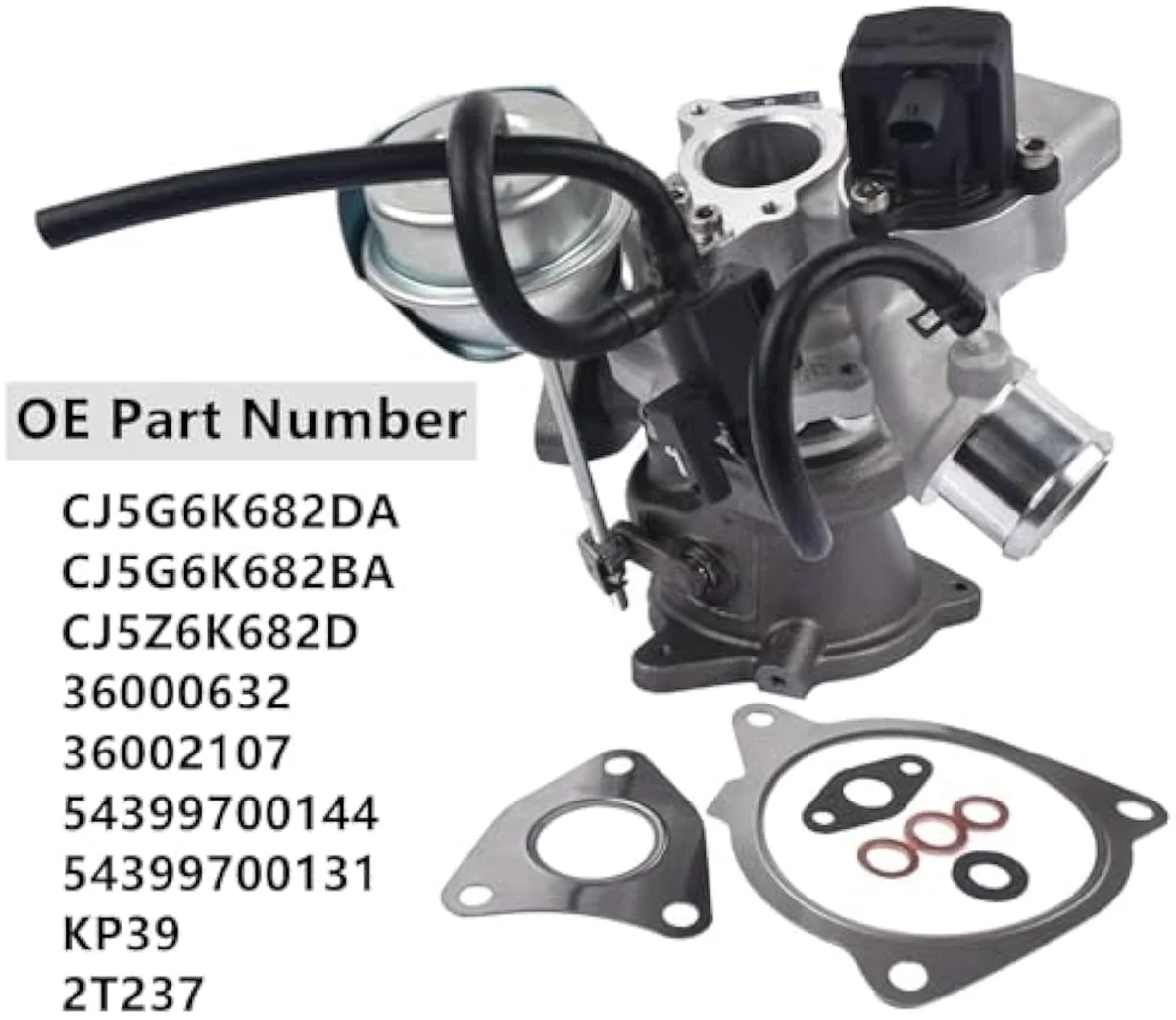
Vahaha publishes the longest OE cross-reference list on the Cluster C lane. Stamp match against the existing failed turbo's casting confirms fitment.
The exact chain:
Chassis Envelope and Application Range
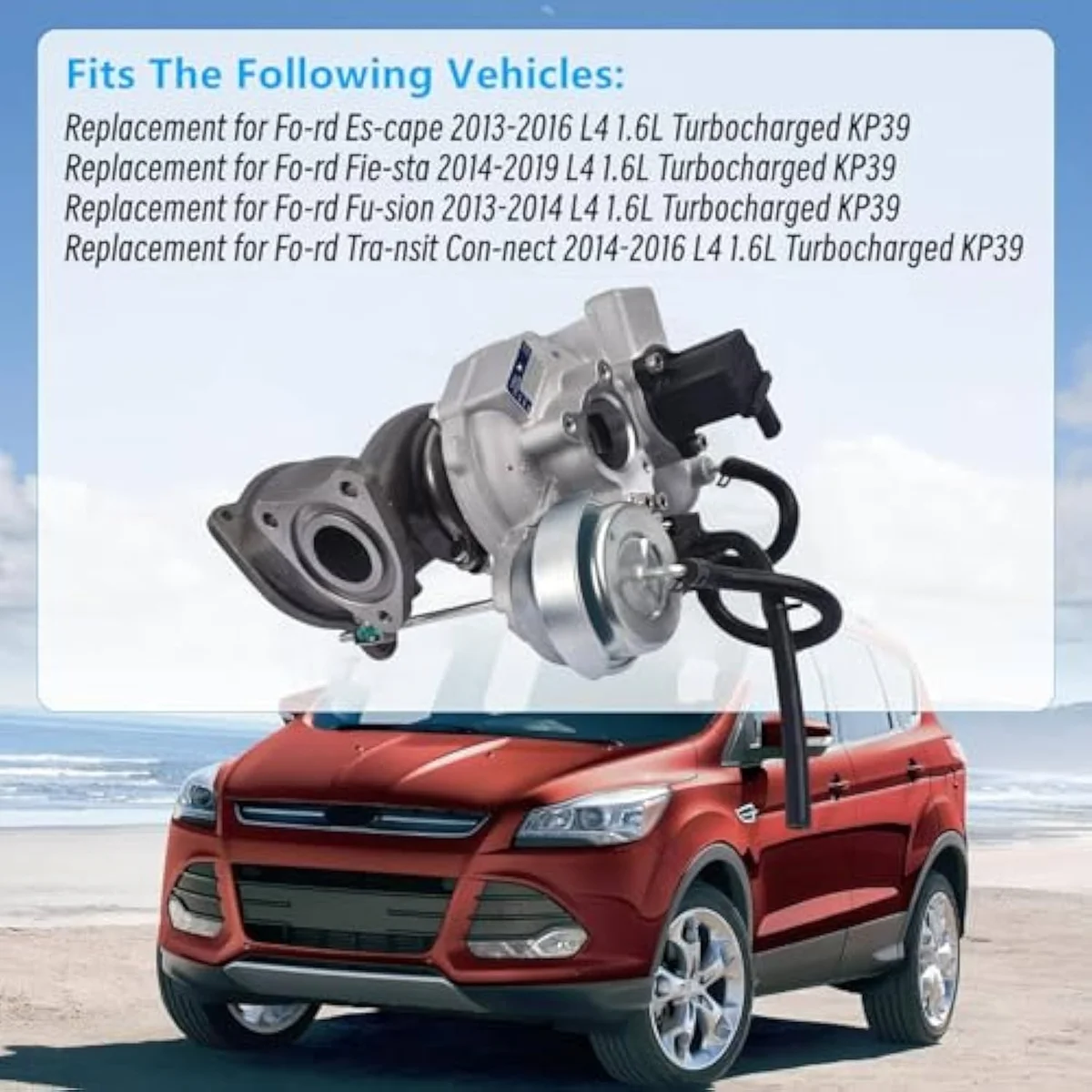
Vahaha's published chassis chain covers four nameplates on the 1.6L EcoBoost L4 engine. The Transit Connect inclusion is the underweighted application on this lane.
The published fitment chain:
Material, Sealing, and Warranty
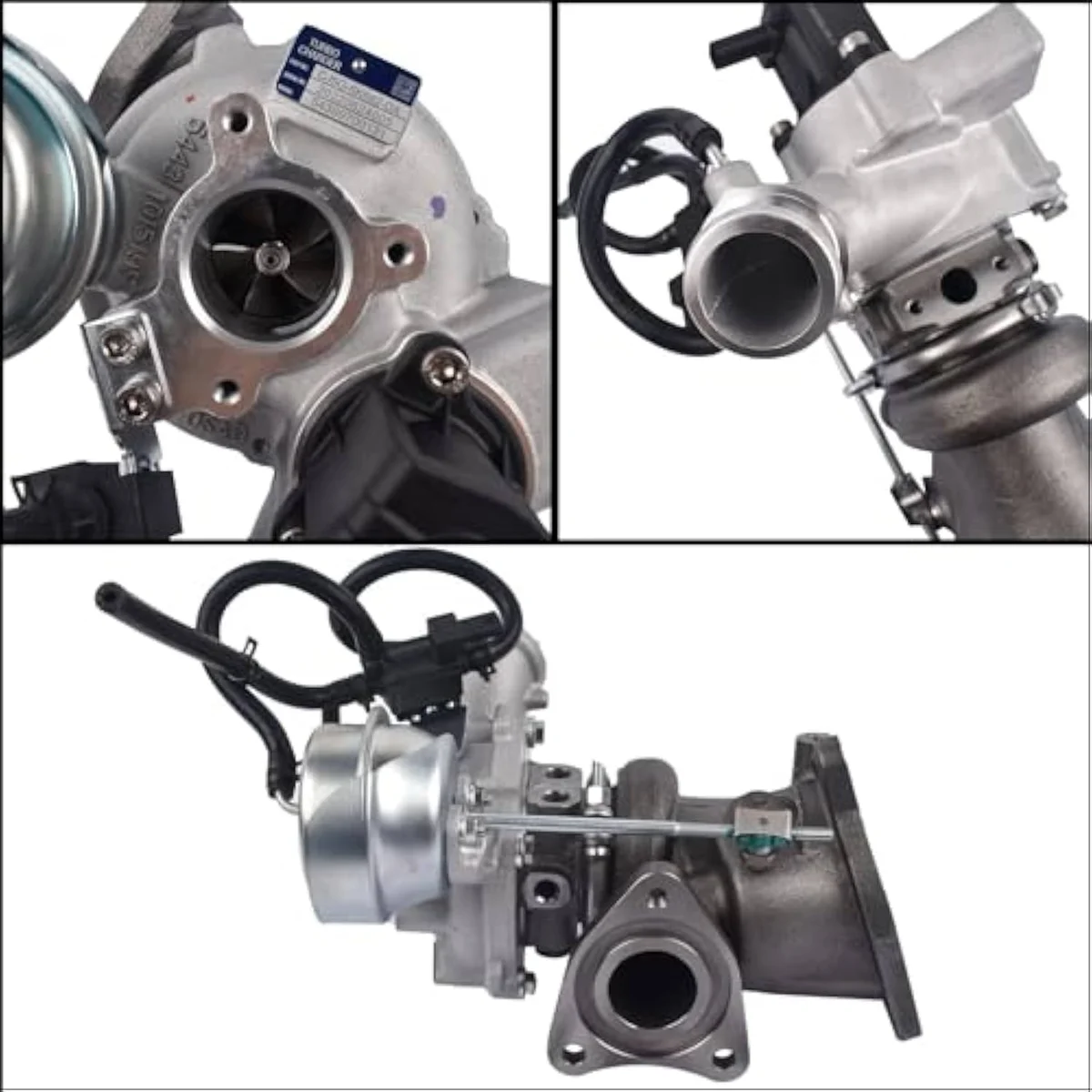
Vahaha publishes three claims on housing construction and ownership-side coverage. The combination matches the standard OE KP39 construction at the Cluster C entry tier.
The housing-material claim:
Verified-Buyer Testimony Pool
Vahaha's verified-buyer testimonial set is the strongest in the Cluster C aftermarket band. Three independent verified-purchase reviews name install outcomes, fitment confirmation, and post-install reliability.
Fitment confirmation on the most-cited chassis:

The value-tier review from a buyer who didn't get to stress-test the unit reported that the
The Wikipedia turbocharger and KP39 frame reference covers the small-displacement turbocharger architecture at the system-design level. The TSReman Turbo University turbocharger catalog publishes the BorgWarner KP39 service-part manifest, and the Rotomaster understanding turbochargers reference covers rebuilder-tier alternatives for buyers cross-referencing the CJ5G chain against premium-tier rebuild options.
The Buying Path
Amazon ASIN B0B7729BRF. Confirm the 1.6L EcoBoost chassis match before clicking through.
The Vahaha KP39 1.6L Turbocharger is listed on Amazon under ASIN B0B7729BRF. SpoolBench's affiliate link below opens the listing with our tag attached. The current price sits at the entry tier for the KP39 frame — among the lowest-spend complete-kit options on the 1.6L EcoBoost lane, and roughly an order of magnitude below the Motorcraft OE part at the dealer parts counter.
Photograph the stamp. Match it against the chain. Order the kit only if the match is clean.
Check Price on Amazon — bundle the kit with new oil and coolant supply / return lines on the install, plus a reputable-shop diagnosis on the underlying failure mode before clocking the new turbo in. Compare against the Weonefit Edge / Explorer / Focus 2.0L review if the chassis is on the larger-displacement K03 lane, the GDUKOP CJ5Z6K682C 2.0L assembly review for the Ford-internal stamp lane on the 2.0L side, or the QBselecar 282312B760 Hyundai Tucson review for the adjacent compact-crossover lane on the Hyundai T-GDI side. Three signals would shift this Vahaha verdict: verified-buyer review pool ≥25 with average rating maintained at 4.5+, documented third-party burst-test data, and published warranty terms exceeding the current one-year floor. Until those land, the strongest verified-buyer evidence in the Cluster C aftermarket band makes this listing the cleanest 1.6L EcoBoost choice.
Our Read on the Data
We synthesize the verified Amazon listing data (9 verified atoms across the nine-number OE chain, chassis envelope, two-material housing claim, sealing-discipline claim, warranty terms, and three independent verified-buyer testimonials), the Amazon Creators API Tier A cache (research/api-cache/static/B0B7729BRF.yaml), the 40-listing 1.6L EcoBoost KP39 shopping segment, and the same atom-substrate research approach used for the rest of Cluster C.
The limits are explicit. We cannot independently verify Vahaha's casting metallurgy or burst-test discipline. We cannot validate the seller's specific Amazon listing identity across the entire counterfeit-risk window. The 11 hash-mismatched atoms in the 2026-05-12 refresh window represent shopping-aggregation drift across the migrated-stub URLs (brand price snapshot, review-pool aggregation, competitor-listing comparisons that moved or were deleted since the 2026-05-07 initial extraction); they are queued for re-extraction but do not gate this editorial verdict.
1.6L vs 2.0L EcoBoost Decisions
- How much does it cost to replace a turbo on a 2013 Ford Escape?
- A 2013 Ford Escape SE 1.6L EcoBoost turbo replacement at the dealer runs in the mid-four-figure band — labor 4-6 hours at dealer rates, parts in the Motorcraft OE tier. The Vahaha KP39 kit on this listing (ASIN B0B7729BRF) sits in the low-three-figure tier on Amazon. Independent-shop labor lands in the mid-three-figure band at standard shop rate. Adding the Vahaha kit plus independent-shop install plus new oil and coolant supply lines lands the all-in total well under half the dealer-quote band. The 2013 Escape SE 1.6L chassis is the most-cited fitment match in the verified-buyer pool on this listing.
- What is the common problem with the Ford Escape 2013?
- The most documented 2013 Ford Escape failure modes are the 1.6L EcoBoost coolant intrusion failure (cylinder-head casting porosity, leading to coolant entering the combustion chamber), the wastegate-actuator wear on the KP39 turbocharger, and the timing-belt-in-oil maintenance schedule unique to the EcoBoost engine family. Ford issued multiple technical service bulletins on the cylinder-head issue and ultimately revised the casting for the second-generation 1.6L. The KP39 turbo wear is independent of the coolant-intrusion issue but the two failure modes share install-side mitigation: replacing oil and coolant supply / return lines on the same job as the turbo replacement.
- How much is a turbocharger for a Ford Escape?
- For the 2013-2016 1.6L EcoBoost Escape, the Vahaha KP39 listing sits at the low-three-figure tier — among the lowest-spend complete-kit options on the lane. The Motorcraft OE replacement on the same chassis runs roughly an order of magnitude higher at the dealer parts counter. Stigan-branded rebuilder-tier alternatives on BuyAutoParts.com land in the mid-three-figure band. For the 2.0L EcoBoost Escape (post-2016 SE Sport / Titanium trims), the K03 frame replacement is the Weonefit, GDUKOP, or QBselecar cross-shop on a different OE stamp chain — those listings live at slightly higher entry-tier pricing than the Vahaha KP39.
- Where is the turbo boost sensor located on a 2013 Ford Escape?
- The 1.6L EcoBoost manifold absolute pressure (MAP) sensor sits in the intake manifold downstream of the throttle body. The boost-pressure (turbocharger outlet pressure) sensor sits between the intercooler outlet and the throttle body inlet on the cold-side intake track. A failing turbocharger triggers a stored P0234 (overboost), P0299 (underboost), P0238 (boost-pressure sensor circuit), or P0246 (wastegate solenoid circuit) code that the OBD-II scanner reads from the engine ECU. The boost-pressure sensor itself rarely fails — when those codes land, the diagnostic decision tree routes to the turbocharger and the wastegate-actuator linkage first.
- What year to stay away from the Ford Escape?
- The 2013-2014 Escape model years carried the highest documented rate of 1.6L EcoBoost coolant-intrusion failures on the first-generation cylinder head — the NHTSA recall page on recalls.gov documents three separate Ford recall campaigns related to the 1.6L EcoBoost from 2014 onward. The 2015-2016 model years carried the revised cylinder head with reduced failure rate. Owners shopping for a used 1.6L EcoBoost Escape should weight the model-year history against the maintenance records; a 2013 Escape with documented cylinder-head replacement under warranty is a more durable buy than a 2014 Escape without that history. The KP39 turbo failure mode is independent of model year — it tracks duty cycle and mileage rather than chassis-year.
- Is the 1.6 or 2.0 EcoBoost better?
- For the same-class chassis where Ford offered both options (2013-2016 Escape and Fusion), the 2.0L EcoBoost produces 240 HP and 270 lb-ft of torque on the K03 frame; the 1.6L EcoBoost produces 178 HP and 184 lb-ft of torque on the KP39 frame. The 1.6L runs better fuel economy at steady cruise; the 2.0L runs better acceleration and tow capacity. Reliability differs sharply — the 1.6L EcoBoost has the documented cylinder-head coolant-intrusion failure mode on 2013-2014 chassis; the 2.0L EcoBoost has the K03 wastegate-housing-integration failure that the Weonefit / GDUKOP Cluster C lane addresses. For a daily-driver Escape buyer prioritising fuel economy, the 1.6L is the right pick on a post-2015 chassis with the revised head. For tow / haul / spirited driving, the 2.0L is the better fit.
Check Price on Amazon · or use our Turbo Replacement Cost Estimator to size the 1.6L Vahaha spend against the 2.0L K03 lane and the Motorcraft OE part at the dealer parts counter.
Get Product Updates
Updates only when something changes.
Only when something changes. Unsubscribe anytime.
Listing-backed sources
- [1]"OE Number】: CJ5G6K682DA, CJ5G6K682BA, CJ5Z6K682D, 36000632, 36002107, 54399700144, 54399700131, KP39, 2T237."https://www.amazon.com/dp/B0B7729BRFCaptured May 7, 2026. Verified May 12, 2026.
- [2]"Replacement for Fo-rd Escape 2013-2016 L4 1.6L Turbocharged KP39; Replacement for Fo-rd Fiesta 2014-2019 L4 1.6L Turbocharged KP39"https://www.amazon.com/dp/B0B7729BRFCaptured May 7, 2026. Verified May 12, 2026.
- [3]"The Turbocharger Compressor Housing and Turbin Housing are made of high-strength aluminum and iron to ensuring better abrasion resistance."https://www.amazon.com/dp/B0B7729BRFCaptured May 7, 2026. Verified May 12, 2026.
- [4]"The precision-machined housing is sealed to prevent leakage."https://www.amazon.com/dp/B0B7729BRFCaptured May 7, 2026. Verified May 12, 2026.
- [5]"Warranty for one year, any issue would be solved immediately."https://www.amazon.com/dp/B0B7729BRFCaptured May 7, 2026. Verified May 12, 2026.
- [6]"It works and fit as a ring in a Ford escape 2013"https://www.amazon.com/dp/B0B7729BRFCaptured May 7, 2026. Verified May 12, 2026.
- [7]"the quality of the turbocharger is top-notch"https://www.amazon.com/dp/B0B7729BRFCaptured May 7, 2026. Verified May 12, 2026.
- [8]"impressed with its reliability and durability"https://www.amazon.com/dp/B0B7729BRFCaptured May 7, 2026. Verified May 12, 2026.
- [9]"Turbo seamed to be of good quality for the price"https://www.amazon.com/dp/B0B7729BRFCaptured May 7, 2026. Verified May 12, 2026.